Wheelie bins are useful, but a row of large plastic containers beside the front door or across the driveway can make even a well-kept home look cluttered. Good wheelie bin storage solves that problem without turning collection day into an obstacle course or trapping unpleasant smells inside a poorly ventilated box. For UK households, the best setup balances appearance, weather resistance, ventilation, security and a clear route from the storage position to the collection point.
The right solution also depends on how many containers your household actually uses. England’s recycling arrangements changed significantly in 2026, while individual councils still decide how services are delivered locally, and arrangements in Scotland, Wales and Northern Ireland differ. That makes measuring your own bins and checking your council’s collection instructions more useful than buying a store simply because it is advertised as a standard double or triple unit.
Quick answer: The best wheelie bin storage is a ventilated timber or metal enclosure on a firm, level surface with enough room to open each lid and roll each bin out easily. Measure every container first, allow extra clearance around it, and keep the route to your property boundary free from steps, tight turns and obstacles.
What Makes Good Wheelie Bin Storage?
A good bin store should hide the containers without making them difficult to use. The doors need to open far enough for a bin to roll straight out, while the top should either provide lid access or leave sufficient headroom for the bin lid to open fully. Ventilation is equally important because completely sealing damp rubbish, recycling residue or food-waste containers inside an enclosure can make odour and condensation problems worse.
The base matters more than many homeowners expect. A level, paved, concrete, or similarly firm surface keeps the unit stable and makes heavy bins easier to move after rain, while soft soil or loose gravel can cause wheels and store legs to sink or shift. Positioning the store close enough to the normal collection route can also save a surprising amount of effort every week.
If you are reorganising the entire household waste system rather than only the outdoor section, ThinkVista’s practical UK kitchen bin guide explains how capacity, recycling compartments and indoor waste separation fit together. Planning the indoor and outdoor arrangements simultaneously can prevent any part of the system from becoming a bottleneck.
Measure Your Bins Before Buying a Store
Do not rely on the words “standard wheelie bin” when ordering storage. Islington Council, for example, lists approximate dimensions of 575 mm wide, 730 mm long and 1,060 mm high for a 240-litre bin, but it specifically warns that dimensions can vary between manufacturers. Your own council may issue containers with different capacities, lid profiles, handles or wheel arrangements, so direct measurement is the safer approach.
Measure the bin with its lid closed first, then check the space it needs in normal use. A storage unit that matches the closed dimensions too closely can be frustrating to use when you try to lift the lid or tilt the container onto its wheels. Allowing modest clearance also improves airflow and makes it easier to clean leaves and debris from around the bins.
Before ordering, record the following details.
- the maximum width of every bin.
- the depth from the front of the body to the furthest point of the handle or wheels.
- the closed height.
- the height with the lid fully open.
- the total width of all containers placed side by side.
- the space needed to tilt and roll each bin forward.
- Any recycling boxes or outdoor food caddies that also need storage.
Place temporary markers on the ground using chalk, tape or spare timber if you are unsure about the footprint. Walk through the entire process of opening the imaginary doors, lifting the lid and rolling the bin towards the kerb. That simple test can expose tight corners and door-clearance problems before you spend money.
9 Wheelie Bin Storage Ideas for UK Homes
1. A Slatted Timber Bin Store
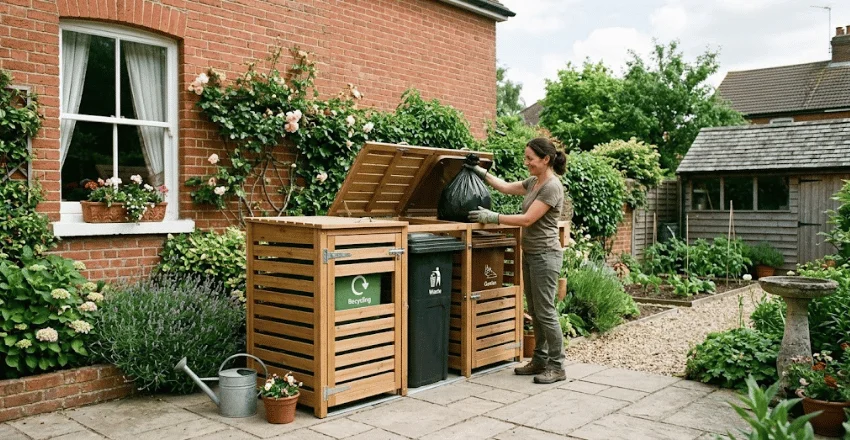
Timber stores are popular because they sit naturally beside fences, sheds and garden planting. Slatted sides allow air to circulate, while a stained or painted finish can make the structure feel like an intentional part of the garden rather than a utility box. Choose treated exterior timber and expect to inspect the finish periodically because British rain and winter moisture can gradually affect exposed wood.
A hinged top can make rubbish disposal easier because you do not need to pull the wheelie bin out every time you add a bag. Some designs link the store lid to the bin lid so that both open together, although simple independent lids have fewer components to maintain. Whatever the design, check that the roof does not restrict a fully loaded bin from being tilted out.
2. A Galvanised Metal Bin Store
Metal storage suits homeowners who want a sharper contemporary appearance and lower routine maintenance. Galvanised or coated steel does not require the same staining schedule as timber and can provide a more substantial barrier against wind, animals and casual interference. The trade-off is usually a higher purchase price and the need to check ventilation carefully.
Metal can also become visually dominant in a small front garden, so colour makes a difference. Dark grey, black and muted green finishes often blend more easily with railings, fencing and planting than bright metallic surfaces. Check the manufacturer’s corrosion protection and fixings if the store will be located in an exposed coastal or high-rainfall area.
3. A Simple Slatted Privacy Screen
You do not always need a complete cabinet. A timber or composite screen placed in front of the bins can hide them from the main sightline while leaving the top, rear and one side open for excellent ventilation. This is especially useful when residents roll out several different containers on separate collection days.
The key is to screen the view rather than block the route. Leave enough width for the largest bin to pass without scraping the screen, and avoid creating a sharp turn immediately outside the storage area. A screen can also be easier to adapt later if your council changes container sizes.
4. Storage Along a Side Passage
A side passage can provide some of the neatest bin storage by removing the containers from the main front-garden view. The passage must still be wide enough for the bin, your hands and the necessary turning movement, particularly if gates or drainpipes narrow the route. Test the route with a full bin rather than an empty one because extra weight makes awkward corners far more noticeable.
Avoid choosing the side passage if collection requires hauling bins through the house. Several councils specifically encourage storage within the property boundary while recognising that access needs to be practical, and local guidance can differ according to property type. A straightforward outside route is normally easier for residents and less likely to damage floors, walls or door frames.
5. A Bin Store With a Living or Planted Roof
A planted roof can turn functional storage into part of the garden design. Low-growing plants soften the appearance of a timber or metal enclosure and can be particularly attractive where the store is visible from an upstairs window. The structure must be designed for the additional saturated weight of the growing medium, plants, and retained rainwater, rather than having a planter improvised on top of a lightweight cabinet.
Plant choice should suit the soil depth, sun exposure, and watering conditions. Low-maintenance species generally make more sense than plants that require constant watering directly above bin lids and hinges. If you are also improving nearby beds or containers, ThinkVista’s guide to bedding plants that slugs tend to avoid offers additional garden-planning ideas.
6. A Mini Wheelie Bin Shed

A small shed-style enclosure is useful where appearance and weather protection are priorities. It can accommodate multiple bins, recycling boxes, caddies, and sometimes a small amount of related outdoor equipment, creating a single organised waste station. Compared with a close-fitting cabinet, however, it requires more ground area and usually more work to build.
The best layout provides wide front doors and enough internal width to remove any one bin without moving all the others first. That becomes particularly important if general waste, recycling, food waste and garden waste are collected on different schedules. Avoid deep layouts where one container is permanently trapped behind another.
7. A Fence-Integrated Bin Bay
Existing fencing can form one or two sides of a simple bin bay, reducing the visual impact and the amount of new material required. Matching new slats, posts or paint to the existing boundary can make the storage area look as though it was designed as part of the garden. It works particularly well where there is already an unused recess beside a gate.
Do not attach a heavy enclosure to a weak or shared fence without checking ownership and structural condition. Independent posts may be a better choice because they keep the weight of doors and roof sections off older fence panels. Make sure the finished arrangement does not reduce the gateway width needed to move the bins.
8. A Lockable Storage Unit
A lockable unit can make sense in exposed front gardens or places where people frequently find unauthorised rubbish in their bins. It can also prevent lightweight lids from blowing open in bad weather, even when the locking system is designed for everyday outdoor use. However, security should never unnecessarily complicate normal disposal or collection.
Think carefully about whether you need to lock the wheelie bins themselves or simply secure the outer enclosure. An enclosure that can be opened quickly on collection day is usually more practical than a system involving several individual locks and keys. Keep spare access arrangements simple enough that every household member can use the store.
9. A DIY Bin Store
Building your own store gives you control over width, height, appearance and the number of bays. It is particularly useful for unusually sized bins or awkward spaces where standard retail units waste valuable centimetres. Treated timber posts, exterior-grade fixings, slatted cladding and a weather-resistant roof can create a straightforward structure without complicated joinery.
Design around the bins rather than copying an attractive photograph. Measure first, allow ventilation, provide diagonal bracing where necessary, and use hinges and latches suitable for outdoor exposure. If the store is tall, heavy or exposed to strong winds, make sure its base and fixings provide appropriate stability.
Timber, Metal or Plastic: Which Material Is Best?
No material is best for every home. Timber usually offers the easiest route to a garden-friendly appearance, metal generally prioritises durability and security, and moulded plastic focuses on simple cleaning and lower maintenance. Your budget, exposure to the weather, and willingness to perform maintenance should therefore determine more than appearance alone.
| Material | Main advantages | Main drawbacks | Best suited to |
|---|---|---|---|
| Timber | Natural appearance, easy to paint or stain, DIY-friendly | Requires periodic maintenance and can deteriorate if neglected | Traditional gardens and custom builds |
| Galvanised/coated metal | Durable, secure, contemporary and low maintenance | Usually more expensive and can look bulky | Modern driveways and exposed front gardens |
| Plastic/resin | Easy to wash, lightweight and resistant to rot | Can fade, flex or look less integrated with landscaping | Practical low-maintenance setups |
| Composite | Consistent finish and reduced timber maintenance | Higher material cost and fewer DIY options | Modern gardens where appearance matters |
Whatever material you choose, airflow and access are more important than an impressive finish. A beautiful enclosure that traps smells or forces you to drag a heavy bin around a corner will soon become irritating. Prioritise the weekly routine first and the decorative details second.
Where Should a Bin Store Go?
The most convenient position is normally within your property boundary, on firm ground, with a short, unobstructed route to the collection point. Some councils explicitly require or expect households with suitable private space to store bins off the pavement between collections. Brighton & Hove, for example, explains that bins should normally be kept in adequate private outside storage where available, while Derby states that bins should be stored within the property boundary.
Avoid blocking pedestrian routes, driveways, visibility at entrances or access needed by neighbours. National guidance allows councils to take action in circumstances where household waste containers cause obstruction, restrict pavement access, attract vermin or have a detrimental effect on local amenity. The exact collection-day rules and enforcement process remain local, so check your own council rather than assuming another authority’s timetable applies to you.
A practical location usually has these features.
- a hard, reasonably level surface.
- direct access to the normal collection route.
- enough room to open store doors fully.
- no major steps or sharp corners.
- reasonable separation from frequently opened windows where possible.
- drainage that prevents standing water.
- enough airflow around the containers.
Do You Need Planning Permission for a Wheelie Bin Store?
Small domestic bin stores often fall into the general territory of garden structures or enclosures, but homeowners should not assume that every design is automatically permitted. For properties in England, the Planning Portal explains that many outbuildings and ancillary garden structures can be permitted development when they meet the relevant limits and conditions. It also recommends contacting the local planning authority when classification or permission is uncertain. Restrictions can also be more important for listed buildings, designated areas or unusual front-garden situations.
Check before building a large permanent structure, altering a boundary, or carrying out work at a listed property. Renters and leaseholders should also check the terms of their tenancy or lease because planning permission and the property owner’s permission are separate issues. Rules differ across the UK’s planning systems, so local advice is more reliable than a blanket statement that bin stores never need approval.
How Much Does a Bin Store Cost in the UK?
Cost depends heavily on material, capacity and whether the store is bought ready-made or built at home. A recent UK garden-storage comparison put DIY timber materials at roughly £80 to £150 and purchased wooden stores at around £150 to £400. Current premium metal products can run from a few hundred pounds for a single or double unit to substantially more for large multi-bin enclosures. Treat those figures as market examples rather than fixed prices, as specifications, delivery charges, and promotions change.
| Storage type | Indicative cost level | What affects the price |
|---|---|---|
| Basic screen | £ | Size, timber treatment and posts |
| DIY timber enclosure | £ to ££ | Timber quality, roof, fixings and number of bays |
| Ready-made timber store | ££ | Finish, capacity, doors and lid mechanisms |
| Plastic/resin unit | ££ | Size, moulding quality and locking system |
| Galvanised metal store | ££ to £££ | Steel thickness, finish, security and capacity |
| Custom-built enclosure | Variable | Labour, foundations, materials and design |
Paying more is worthwhile when the extra cost solves a real problem, such as exposure to strong wind, the need for secure storage or an awkward custom footprint. Decorative details alone are less valuable if the doors are narrow or access is poor. Measure first, then compare models that genuinely fit.
Keeping a Bin Store Clean and Free From Smells
A bin enclosure should be ventilated rather than airtight. Keep bin lids closed, deal with spills promptly, and occasionally sweep or wash the floor beneath the containers so old residue does not remain hidden. Outdoor food-waste caddies deserve particular attention because small leaks can create smells even when the main wheelie bins are clean.
Do not depend on perfume sprays to compensate for dirty containers. A regular rinse where your council or bin provider allows it, sensible bagging of residual waste and proper separation of food waste will usually make a larger difference. Good airflow also helps surfaces dry after rain or washing, rather than keeping the enclosure permanently damp.
Inspect timber, hinges, latches and ground fixings at least periodically. Small repairs are easier when caught before a loose door starts twisting the frame or exposed timber absorbs repeated winter rain. For more seasonal household jobs, ThinkVista’s wider home improvement guides provide further maintenance and practical planning advice.
Bin Storage Ideas for Small Front Gardens
Small front gardens benefit from storage that hides the bins from the main viewing angle rather than enclosing every side. A simple screen, a narrow custom-built bay, or a store positioned parallel to a wall may preserve more usable space than a deep freestanding cabinet. Measure the remaining path width after installation because the storage should not make everyday pedestrian access uncomfortable.
Colour and visual weight also matter in compact areas. Matching the store to an existing fence, gate or wall helps it recede into the background, while vertical slats can create a cleaner appearance than a collection of mismatched containers. Avoid oversizing the structure for hypothetical future bins unless you genuinely expect your household container requirements to change.
Final Verdict
The best wheelie bin storage is not simply the enclosure that hides the most plastic from view. It is the one that fits your actual containers, stays ventilated, survives UK weather and lets you move a full bin from storage to the collection point without awkward lifting or tight turns. For most homes, a well-sized timber or coated-metal store on a firm base will provide the strongest balance of appearance, durability and everyday convenience.
Start by measuring every bin, caddy and recycling box you currently use, then mark the proposed footprint on the ground. Check your local council’s storage and collection guidance before committing to the position, especially in a small front garden or near a public pavement. Once those practical details are in place, choose the material and design that best complement your home.
Bin Store FAQ
Measure your own bin because 240-litre models are not perfectly identical. As one UK council reference point, Islington lists approximate dimensions of 575 mm wide, 730 mm long and 1,060 mm high, while noting that manufacturers can vary. Add enough clearance for the lid, handle, wheels, ventilation and forward movement rather than buying a store with identical internal dimensions.
You should check your local council’s rules, but households with suitable private outside space are commonly expected to keep their containers within the property boundary between collections. Councils may take action where bins create an obstruction, restrict access or contribute to nuisance. If your property genuinely has no suitable storage area, your council may have different arrangements or guidance.
Yes, some airflow is highly desirable because waste containers can hold moisture, food residue and damp packaging. Slatted sides, ventilation gaps or open-backed designs help moisture escape rather than remaining trapped inside the enclosure. Ventilation does not replace cleaning, but it makes a clean store easier to keep fresh.
Timber is generally easier to customise and often blends naturally with fences and garden features. Metal usually requires less decorative maintenance and can provide stronger security, although it tends to cost more. The better option is the one that fits your site, maintenance preferences and budget while providing adequate access and ventilation.
Locking can be useful if other people place waste in your containers, animals disturb the bins or the store is exposed to tampering. However, a complicated locking arrangement can become frustrating when several household members use the bins every day. Choose straightforward security that can be opened quickly before collection.