The right kitchen bin should fit your household’s waste routine before it fits your décor. Current UK product tests focus on capacity, opening style, recycling layout, cleaning, and odour control. This guide compares those factors so you can choose a practical setup without paying for features you won’t use. Our related guide, Wheelie Bin Storage, goes further into this.
Short answer: Start with capacity and waste sorting, then choose the lid style. Which? Suggest 20 to 30L for one person, 30 to 40L for couples or small households, 40 to 50L for households of three or four people, and 50L or more for larger homes. Measure the available floor space, lid clearance, and inner-bucket removal space before you order.
What to Decide Before You Buy
| Decision | Practical starting point | Why it matters |
|---|---|---|
| Capacity | 20L to 50L+, depending on household size | Affects emptying frequency and floor space |
| Lid | Pedal, sensor, touch, or manual | Changes convenience, contact, and maintenance |
| Waste sorting | Single or divided compartments | Makes recycling easier at the point of disposal |
| Footprint | Measure width and depth | Litres alone don’t tell you whether it will fit |
| Opening clearance | Measure above and around the unit | Tall lids can hit worktops, walls, or cabinets |
| Cleaning | Look for removable buckets and simple edges | Spills and residue are easier to deal with |
| Budget | Roughly £15 to £200+ across the market | Extra cost often pays for materials, mechanisms, and sorting features |
Current UK reviews show a broad price range. The Telegraph reports basic plastic options from about £15, while premium designs can exceed £200. Sensor systems, extra compartments, and odour-control features tend to add to the cost.
Key takeaways
- Choose capacity based on your household size and how often you want to empty the bin.
- A pedal model is a strong, low-maintenance choice if you want hands-free opening without batteries.
- Divided designs make sense when you keep dry recycling indoors.
- Measure the lid movement and bucket-removal space, not only the floor footprint.
- England’s 2026 recycling changes make food-waste and recycling separation more relevant for many households.
How to Choose a Kitchen Bin That Fits Your Routine
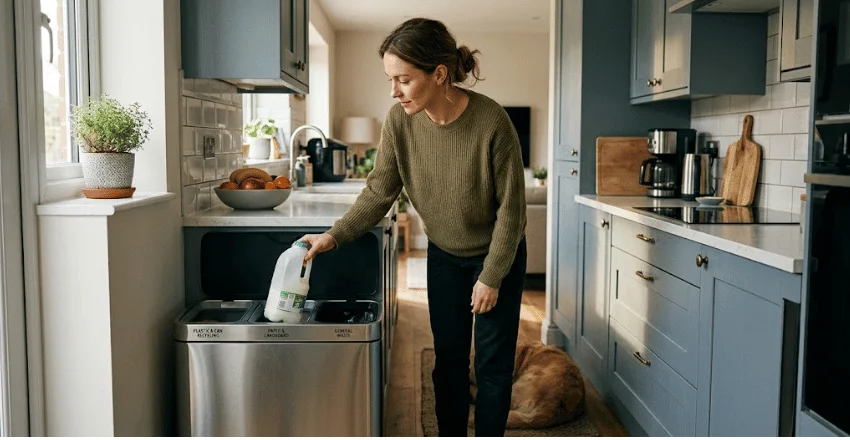
Capacity is a sensible first filter. Guidance published by Which? in July 2026 suggests 20 to 30 litres for one-person households or compact kitchens. It places couples and smaller households in the 30-40-litre range. Families of three or four generally fall into the 40 to 50-litre range, while larger households may prefer 50 litres or more.
Those ranges are starting points, not fixed rules. A family that separates food scraps and most packaging may produce less residual rubbish. In that case, a smaller model that is emptied regularly could work better than one large container.
Space can change the answer too. ThinkVista’s small-kitchen layout and storage ideas focus on preserving useful floor area and traffic flow. A slim or vertical waste station often suits that approach better than a wide unit. The ThinkVista guide covers layouts designed for limited spaces.
Use the three-measure fit test
Before ordering, measure three things:
- Floor footprint: Record the available width and depth.
- Opening clearance: Check how far the lid travels upward or outward.
- Removal clearance: Ensure an inner bucket can be lifted out without hitting the worktop.
That third measurement is easy to miss. A model can fit neatly under a counter, yet become awkward to use whenever you change the liner.
Pedal, Sensor, Touch, and Divided Designs Compared
Opening mechanisms change how the unit feels in daily use. Recent UK reviews cover pedal, sensor, touch-top, and multi-compartment designs rather than treating them as interchangeable.
| Type | Pros | Cons | Suits |
| Pedal | Foot-operated; no batteries; familiar mechanism | Pedal needs floor access; moving parts can wear | Busy kitchens and everyday use |
| Sensor | Opens without hand or foot contact | Needs power; electronics add complexity and cost | Users who prioritise touch-free access |
| Touch-top | Simple opening; often neat and compact | Requires hand contact | Design-focused spaces and lighter use |
| Divided | Sorts rubbish and recycling in one footprint | Each section has less capacity; can be heavier | Homes that store recycling indoors |
| Slimline | Uses narrow gaps efficiently | Smaller capacity for its height | Flats and compact kitchens |
| In-cupboard | Keeps waste out of sight | Uses cabinet storage and may limit capacity | Minimal interiors with suitable cabinets |
A pedal model is a practical default for many households. It gives you hands-free opening without batteries or sensors. Current UK product tests continue to feature pedal mechanisms prominently alongside sensor designs.
Sensor models make sense when touch-free access matters more than simplicity. They can also help someone who finds a foot pedal inconvenient. Check the battery requirements, lid-removal method, and sensor position before buying.
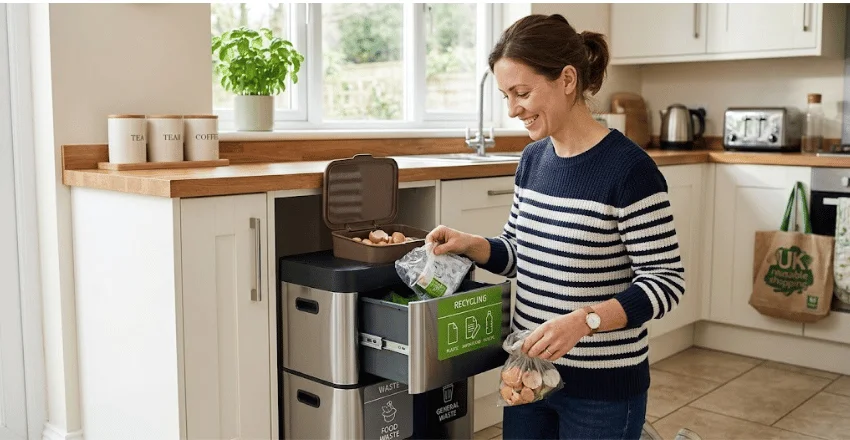
A divided unit makes good use of its space when you already separate dry recycling indoors. Which? Specifically notes that dual compartments can combine general waste and recycling in one unit, provided each section is large enough for your needs.
Recycling and Food Waste in England in 2026
Waste sorting deserves more attention this year. Under England’s Simpler Recycling requirements, changes to household collections took effect on 31 March 2026, although transitional arrangements apply to food-waste collection in some local authority areas.
The national guidance covers separate waste streams for food and garden waste, paper and card, other dry recyclables, and residual rubbish. Your indoor setup doesn’t need to copy your outdoor containers exactly. It should simply make those waste streams easy to separate before collection.
A practical indoor arrangement could include:
- a small food-waste caddy;
- one compartment for general rubbish;
- one larger area for accepted dry recycling.
If your council collects paper separately, you may want another small container or storage point. Check your local authority’s current instructions before changing your system. Rules in Scotland, Wales, and Northern Ireland are separate from England’s Simpler Recycling framework.
In a small room, stacked or vertically divided designs can prevent waste sorting from taking over the floor. That makes recycling capacity a space-planning issue, not merely an environmental feature.
Materials, Odour Control, and Cleaning
Stainless steel looks tidy and is common in premium designs. Plastic is lighter and often costs less. The more useful question is how easily you can clean the surfaces that come into contact with spills.
Which? evaluates cleaning by checking awkward corners, hinges, rims, and exterior marks. Its testing also considers lid operation and odour containment. Those criteria are worth using when you inspect a product in a shop or read its specifications.
Look for:
- a removable inner bucket;
- smooth internal surfaces;
- accessible hinges and lid edges;
- liners that fit without slipping;
- a lid that closes consistently.
Odour filters can be useful, but they don’t replace routine cleaning or sensible food-waste separation. A complicated deodorising feature may offer poor value if replacement filters are difficult to find.
How Much Should You Spend?
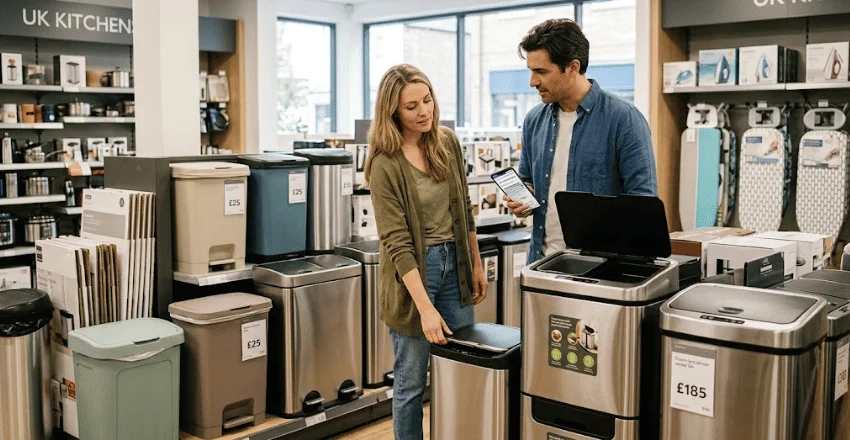
Current UK prices cover a wide range. The Telegraph’s April 2026 review places basic plastic models at around £15 at the entry level. Premium brands and feature-heavy systems can cost £200 or more.
Price alone doesn’t tell you how well a product will suit your home. Spending more can give you stainless-steel finishes, sensors, built-in liner storage, food caddies, odour-control systems, or multiple compartments.
Start with function. Pay more only when an extra feature solves a problem you already have. A mechanical pedal design can make more sense than a costly sensor unit if easy opening is your only priority.
The same rule applies to other space-hungry household equipment. ThinkVista’s UK ironing-board guide compares size and practical features before recommending different options.
A 7-Point Buying Checklist
Use this checklist before you place an order.
- Measure the available floor area. Note the maximum width and depth.
- Check the lid path. Make sure it won’t hit a counter, wall, or shelf.
- Allow removal space. Confirm that buckets and liners can be removed easily.
- Choose capacity based on your routine. Factor in household size, recycling, and emptying frequency.
- Map your waste streams. Decide where food scraps, recyclables, and residual rubbish will go.
- Pick the simplest lid that suits you. Don’t pay for electronics unless they improve daily use.
- Check cleaning and liner costs. Replacement bags, filters, and accessories affect long-term value.
This approach separates practical measurements from marketing claims. It also prevents a common buying mistake: choosing based on capacity alone, only to discover that the shape or opening mechanism doesn’t work in the room.
Verdict: Which Type Makes Sense for Most Homes?
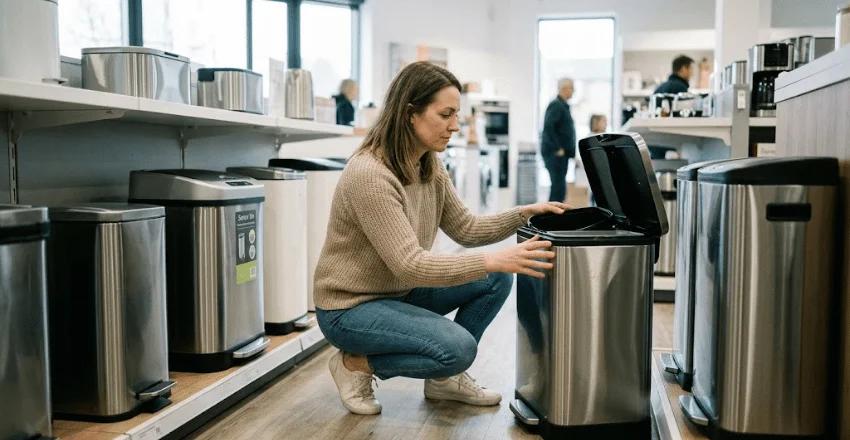
For a three- or four-person household, a 40 to 50L pedal model is a sensible starting point based on current guidance from Which?. Choose a divided version if you keep dry recycling indoors. A smaller 30 to 40L option may suit homes that separate food waste and packaging efficiently.
Pick a sensor model when touch-free access is worth the additional electronics. Choose a slimline or vertical design where floor space matters most.
There’s no reason to buy the largest capacity your kitchen can hold. Buy the smallest size that handles your normal waste comfortably without forcing you to empty it constantly.
Measure First, Then Choose the Features
Take three measurements today: floor width, floor depth, and opening clearance. Then decide how you separate food waste, recycling, and residual rubbish.
Once those basics are clear, choosing the right capacity and lid becomes much easier. For more practical household-planning and buying advice, browse ThinkVista’s home improvement guides.
Kitchen Bin FAQ
A 40 to 50L capacity is a useful starting point. Which? This range suits families of three or four because it balances space with emptying frequency. Your recycling habits may allow you to choose a smaller capacity.
Choose a pedal system for mechanical simplicity and hands-free opening without batteries. Pick a sensor system if touch-free operation matters enough to justify the power requirements and extra components.
Not necessarily. A divided design is useful when you store recycling beside general rubbish. Separate containers may work better if your local collection system requires several waste streams or if one stream fills much faster than another.
Start with a slimline, narrow, or vertically divided design. Measure the opening motion carefully. Butterfly-style lids and other low-clearance openings can help where cabinets restrict upward movement.
Material alone doesn’t solve odour problems. Lid fit, food-waste separation, smooth internal surfaces, and easy cleaning matter more. Choose a design you can empty and wash without dealing with awkward corners.
Place it somewhere convenient for food preparation and cleaning without blocking a walkway. The Telegraph’s 2026 guide cites kitchen-design advice that favours placing a bin near the main work area or sink.