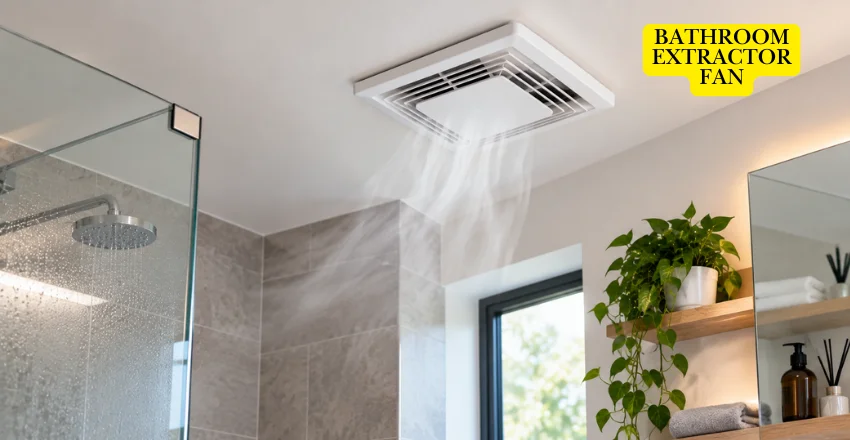
A bathroom extractor fan removes moisture-laden air before condensation has time to settle on mirrors, walls, and ceilings. Choosing one involves more than matching a new unit to an existing hole, because airflow, duct length, noise, and controls all affect real performance. For UK homes, you also need to consider ventilation guidance and electrical bathroom zones before installation.
Direct answer: For most UK homes, 15 litres per second, or about 54 m³/h, is a useful bathroom airflow benchmark used in current England and Scottish guidance. Choose the motor type around the duct route, then compare noise, controls, and bathroom-zone suitability. Longer or restrictive ducts often need more capable equipment than a simple axial wall fan.
| Bathroom Extractor Fan | Practical starting point |
|---|---|
| Intermittent airflow | At least 15 l/s, about 54 m³/h, where applicable |
| Fan type | Axial for short routes; inline or centrifugal for more resistance |
| Control | Basic switch, timer, humidistat, or continuous operation |
| Noise | Compare dB(A) figures at the same stated distance. |
| Ducting | Keep the route short, smooth, and direct where possible. |
| Wet-zone installation | Check IP rating and manufacturer instructions. |
| Installation | Use a registered electrician for bathroom electrical work. |
How to choose a bathroom extractor fan: 7 checks before buying
Start with the room and ventilation route rather than appearance or price. A quiet premium unit can still disappoint if it cannot overcome a restrictive duct, while an unnecessarily powerful model may create more noise than you want. These seven checks narrow down your choices before you compare individual models.
- Confirm the required airflow. For intermittent bathroom extraction, 15 l/s is the key benchmark in current Approved Document F guidance for England. That converts to about 54 m³/h.
- Measure the duct route. Note its length, diameter, number of bends, and where the air exits outdoors. A short route through an external wall creates less resistance than several meters of ceiling duct.
- Match the motor design to the route. Axial models suit simple installations, while centrifugal and inline designs are commonly chosen when more pressure is required.
- Decide how it should switch on. A timer works predictably after use, while a humidistat responds to moisture levels. Continuous systems run at a low background rate and boost when needed.
- Compare noise on equal terms. Check the stated dB(A) figure and the measurement distance. A lower figure matters more in an en suite or bathroom beside a bedroom.
- Check the installation zone. A unit placed in bathroom zones 1 or 2 needs suitable moisture protection and must be approved by its manufacturer for that location.
- Budget for the whole installation. Wiring, core drilling, ducting, an exterior grille, and making good can cost more than the fan itself. A direct replacement is usually simpler than creating a new ventilation route.
Axial, centrifugal, inline or continuous: which type should you choose?
The installation route is the quickest way to separate these options. Axial models move air efficiently through a short, low-resistance path, while other designs can cope better with longer or less direct ducting. The table below compares their useful strengths and trade-offs rather than treating one design as suitable for every bathroom.
| Type | Good fit for | Advantages | Trade-offs |
|---|---|---|---|
| Axial | External-wall bathrooms with short ducts | Compact, widely available, often inexpensive | Performance can fall on restrictive routes. |
| Centrifugal | Longer ducts or routes with greater resistance | Better pressure capability | Often larger and can cost more |
| Inline | Ceiling vents with a loft or void above | The motor can be located away from the room; it is useful for longer duct runs. | Needs accessible void space and careful duct installation |
| Continuous/dMEV | Homes needing steady background extraction | Low-rate ventilation continues throughout the day. | Different sizing and commissioning considerations apply. |
For a typical bathroom on an external wall, an axial model is often the simplest choice if the duct is short and direct. For an internal bathroom, loft installation, or a longer route, an inline or centrifugal design deserves closer attention. The useful verdict is therefore to choose by duct resistance first and extra features second, rather than buying by fascia style.
Bathroom ventilation rules in the UK in 2026
Building regulations are devolved, so there is no single document that covers every UK property. In England, the 2021 edition of Approved Document F remains relevant to work under the current standards in September 2026, and it specifies a minimum intermittent bathroom extract rate of 15 l/s.
The newly published 2026 edition takes effect for most relevant English building work on 24 March 2027, subject to transitional arrangements. Wales also has its own Approved Document F arrangements, with its new 2026 dwelling guidance taking effect on 4 March 2027. Scotland’s January 2025 Domestic Technical Handbook specifies 15 l/s for intermittent extraction from a bathroom or shower room, while Northern Ireland uses Technical Booklet K for ventilation guidance.
Check the rules that apply to your nation and project, rather than assuming an England-specific requirement automatically applies throughout the UK. England’s current guidance also says extract terminals and fans should be positioned as high as practical and no more than 400 mm below the ceiling.
For a room without an openable window, intermittent extraction should continue for at least 15 minutes after the room is vacated. These details explain why placement and controls can matter as much as the airflow number printed on the box.
Timer, humidistat, or basic switching?
A basic switched fan is inexpensive, but its performance depends on how long somebody leaves it running. Timer controls extend the operating period after the light or control is switched off, which is useful because humidity remains after a shower ends. Humidistat models react to measured moisture and can operate without relying entirely on the user’s routine.
| Control | Main advantage | Consider before buying |
|---|---|---|
| Basic switch | Simple operation and lower purchase cost | The user can switch it off too early. |
| Run-on timer | Keeps clearing moisture after use | Usually needs suitable wiring for timer operation |
| Humidistat | Responds automatically to humidity | Sensor setup and room conditions affect operation. |
| Continuous with boost | Maintains regular background ventilation | Should be selected as part of the home’s ventilation approach |
For a busy family bathroom, a humidity sensor can reduce dependence on people remembering to leave ventilation running. A timer is often a sensible middle ground when the room has predictable use and suitable wiring. If the room has no openable window in England, ensure the controls comply with the applicable run-on guidance.
Why airflow, noise, and ducting need to be considered together
The airflow printed on a specification sheet does not tell the whole story because the finished duct system adds resistance. Long routes, tight bends, crushed flexible ducting, and restrictive exterior grilles can reduce the amount of air moved from the room. Scotland’s current handbook specifically tells designers to consider duct resistance and requires completed systems to be checked against their intended airflow.
Noise also needs context, especially for an en suite or a bathroom used late at night. Compare figures measured using the same method and distance, rather than assuming that a small numerical difference always represents a fair comparison. If quiet operation matters, reducing unnecessary bends and fitting the ventilation route correctly can be as valuable as choosing a quieter motor.
Bathroom zones, IP ratings, and electrical safety
A bathroom is a special electrical location because equipment can sit close to baths and showers. IET guidance states that suitable 230 V ventilation equipment can be installed in zones 1 and 2, but equipment there requires at least IPX4 protection, or IPX5 where water jets are likely. Manufacturer instructions still matter, because the product must be suitable for its intended position.
Electrical Safety First recommends using a registered electrician to advise on replacement or installation work. Bathroom wiring, isolation, and protective measures require more care than mounting a grille or cleaning an existing cover. If renovation leaves an opening that needs repair, ThinkVista’s plasterboard guide can help you understand common board types before the surface is made good.
How much does bathroom fan installation cost in the UK?
Installation cost depends heavily on whether you are replacing an existing unit or creating a new route through the building. Checkatrade’s 2026 figures put an average replacement at about £200 and a new installation at about £300, with an average bathroom fan unit around £75. These are guide prices rather than quotes, and access, location, wiring, and ductwork can move the final figure.
A like-for-like replacement can therefore cost less than relocating the vent or adding extraction to an internal room. Before comparing quotes, ask what the price includes, such as the unit, electrical work, ducting, exterior terminal, and making good. This prevents a low headline price from becoming expensive once the missing work is added.
Maintenance and signs that ventilation is underperforming
Dust on the grille can restrict airflow and increase noise, so include the fan in normal home maintenance. Electrical Safety First warns that dirt and debris can block the intake, hinder the blades, and contribute to overheating or greater noise. ThinkVista’s 2026 home maintenance checklist gives you a useful place to include regular ventilation checks.
Persistent condensation, mould around cold surfaces, or steam that remains for a long period can indicate that ventilation needs attention. Cleaning an accessible cover may help, but recurring problems can point to poor airflow, obstructed ducting, or an unsuitable system. For broader indoor air questions, ThinkVista’s Air Purifier UK guide explains air-cleaning equipment, although filtration does not replace the need to remove humid air from a bathroom.
The final buying decision
Measure the duct route, identify the mounting position, and establish the required airflow before choosing features. For a short external-wall route, an axial model may be sufficient; for longer or more restrictive ducting, compare inline and centrifugal options and assess their performance under resistance.
Then choose the control, noise level, and wet-zone rating that suit the room, and arrange competent electrical installation where required.
Frequently asked questions
What size bathroom extractor fan do I need?
For many intermittent domestic installations, start by checking whether the unit can deliver at least 15 l/s (about 54 m³/h). That figure is the minimum bathroom rate in current England guidance and Scotland’s current domestic handbook. A longer or restrictive duct may require a model capable of maintaining the required airflow against greater resistance.
Is a humidistat better than a timer?
Neither control is automatically right for every household. A timer gives a predictable run-on period, while a humidistat responds when moisture reaches its set level. A humidistat is especially useful where users tend to switch ordinary ventilation off too soon.
Does the fan need to run after the bathroom light goes off?
It depends on the ventilation design and the room. In England, the current Approved Document F guidance states that an intermittent fan in a room without an openable window should run for at least 15 minutes after the room is vacated. A suitable timer or automatic control can provide that continued extraction.
Can I install the fan myself?
You may be able to handle non-electrical preparation if you have the right skills, but bathroom electrical work needs particular care. Electrical Safety First recommends using a registered electrician for installation or replacement advice and work. A professional can also check the wet-zone position, isolation, wiring, and whether the completed ventilation rate is suitable.