A weed burner can make clearing unwanted growth from paving, paths and driveway joints far less tedious than pulling every small weed by hand. Instead of applying herbicide, these tools use concentrated heat to damage plant tissue, with UK buyers generally choosing between gas-powered flame models and electric hot-air models. The important part is choosing the right type for the area you want to treat and understanding that these machines are high-temperature tools rather than devices for literally setting weeds alight.
Quick answer: This kind of tool uses intense heat to damage weed leaves so the plant wilts and dies. Gas models provide an open flame and greater mobility, while electric models use concentrated hot air and are often convenient for patios and paths. Neither type should be used where dry vegetation or other combustible materials could catch fire.
What Is a Weed Burner?
This is a thermal weeding tool designed to expose unwanted plants to a short burst of high heat. The purpose is to damage the plant’s cells rather than burn the weed into ash, and treated foliage normally wilts after exposure. University horticultural guidance on flame weeding explains that rapid heating damages cell structure and causes the plant to lose water, eventually killing susceptible growth.
This makes thermal treatment particularly useful for small weeds growing where digging or hoeing is inconvenient, such as between paving slabs. Young broad-leaved weeds generally respond better than established grasses and deep-rooted perennial weeds because many tougher plants can regrow from protected growing points or roots. Repeated treatment may therefore be necessary instead of expecting one pass to permanently clear every weed.
Gas vs Electric Weed Burners
The biggest buying decision is whether to choose a gas or electric model. Both types work by delivering damaging heat to plant tissue, but they differ considerably in mobility, operating style, and fire risk. The best option depends on where you will use it, how much ground you need to cover, and whether convenient access to an outdoor power supply is available.
| Feature | Electric Model | Gas Model |
|---|---|---|
| Heat source | Concentrated hot air | Direct gas flame |
| Typical power supply | UK mains electricity | Gas canister or cylinder |
| Mobility | Limited by cable or extension lead | Highly mobile |
| Open flame | No | Yes |
| Best suited to | Patios, paths and smaller paved areas | Larger hard-surface areas and locations away from sockets |
| Main drawback | Cable management and slower working pace | Greater open-flame and fuel-handling risk |
| Storage considerations | Allow hot nozzle to cool | Cool burner fully and store gas safely |
| Fire risk | Still significant because of extreme heat | Significant because of extreme heat and exposed flame |
Electric Models

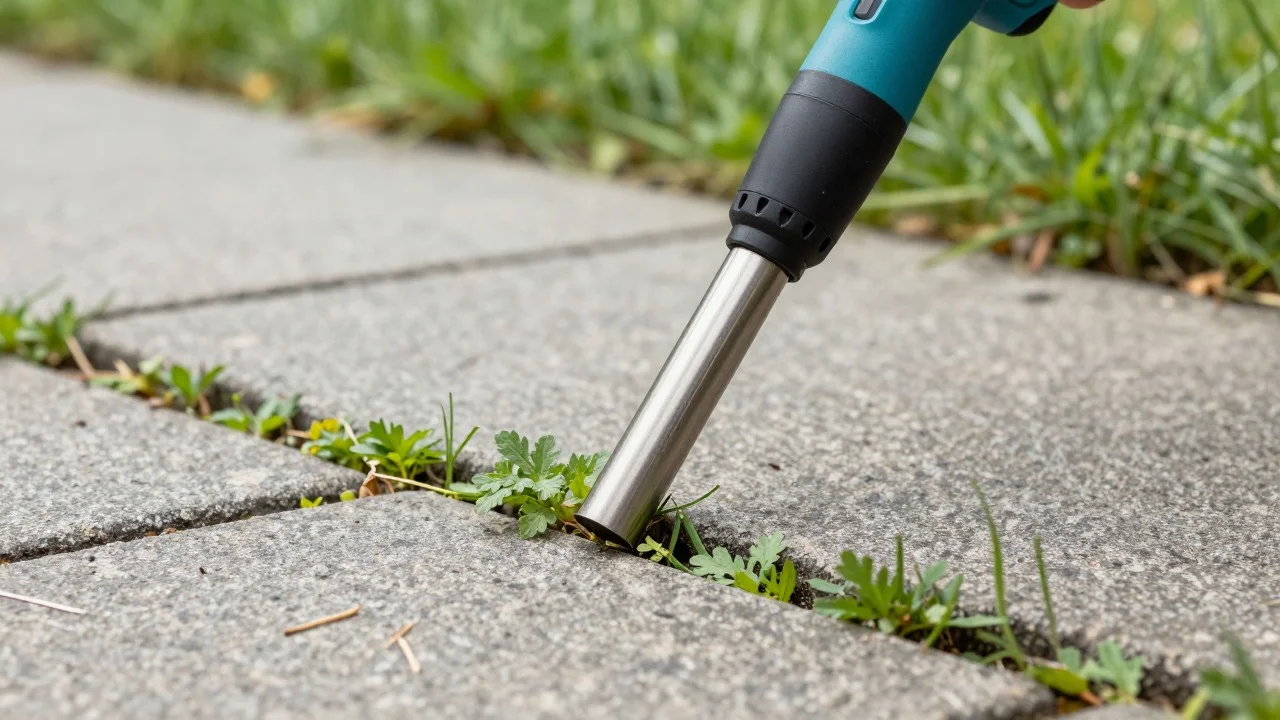
Electric models use a heating element and airflow to direct very hot air onto the plant. Current UK retail listings commonly show 2,000W machines with high-temperature settings around 600–650°C, although specifications vary between manufacturers. Their absence of an exposed gas flame can make them feel easier to manage around a typical paved garden, but the nozzle and outgoing air remain hot enough to ignite combustible material.
An electric model is worth considering when most of your weeds appear on a patio, path or driveway close to a suitable electrical supply. Check the machine’s weight, cable length, nozzle design and whether you can comfortably maintain an upright working position before buying. If an extension lead is required, follow the equipment manufacturer’s electrical instructions and keep plugs and connections protected appropriately while working outdoors.
Gas Models
Gas-powered burners produce a direct flame and remove the restriction of a mains cable, making them convenient over larger or more remote areas. They can also produce very intense heat quickly, which means the operator needs particularly good control over the direction of the burner. Gas models introduce additional considerations involving cylinders or cartridges, ignition, fuel connections and safe storage after use.
Fire services in the UK have recorded incidents in which these tools ignited vegetation, fencing, sheds and other nearby property. Shropshire Fire and Rescue Service has specifically warned that gas burners can produce an extremely hot flame capable of igniting surrounding materials if mishandled. For that reason, greater mobility should never be treated as permission to use a gas burner close to combustible garden structures.
Where Does Thermal Weeding Work Best?
This approach is most useful where weeds are isolated from plants and materials you want to protect. Paving cracks, block-paving joints, gravel paths and certain driveway edges are typical examples because heat can be concentrated on the unwanted plant rather than a crowded flower bed. Always check that the surface itself is suitable for high-temperature treatment, because some plastics, membranes, sealants and decorative finishes may be damaged by heat.
Good locations include the following.
- Weeds between paving slabs.
- Block-paving joints.
- Suitable driveways.
- Gravel paths.
- Path edges.
- Open hard-standing areas.
- Small weeds away from desirable plants and combustible materials.
Poor locations include the following.
- Wooden decking.
- Dry lawns or grass.
- Bark or dry mulch.
- Artificial grass.
- Areas beside sheds or timber fencing.
- Dense flower borders.
- Areas close to dry hedges.
- Spaces near stored fuel or gas cylinders.
Patios, Paths and Driveways
Hard landscaping is where thermal weeding normally makes the most practical sense. Small weeds emerging through joints can be awkward to remove completely by hand, while targeted heat allows you to work without spraying the surrounding surface with herbicide. Horticultural guidance identifies driveway and patio cracks as areas particularly suited to flame weeding when desirable plants are not close to the target.
Do not assume every paved surface is automatically heatproof, however. Resin, plastic edging, jointing compounds, and other heat-sensitive materials may react differently from stone or concrete, so the surface manufacturer’s guidance should take priority. Test an inconspicuous spot when appropriate and keep the heat source moving rather than holding it unnecessarily against the paving.
Flower Beds and Lawns
A thermal burner is generally a poor choice among valuable plants because heat is non-selective. The tool cannot distinguish between a weed and a flower, vegetable or lawn grass, so accidental exposure can injure plants you intended to keep. Hand pulling, hoeing, mulching and other targeted methods are usually more controllable in beds and borders.
The Royal Horticultural Society recommends several non-chemical approaches to weeds, including hand removal, hoeing, repeated cutting, smothering and barriers. These methods are particularly useful where applying intense heat would risk nearby vegetation or combustible material. Gardeners interested in combining different low-chemical-maintenance approaches can also read Thinkvista’s guide to bedding plants that slugs hate for another perspective on designing easier-care garden areas.
How to Choose the Right Model
Choosing the best machine is less about finding the highest possible temperature and more about matching the equipment to your garden. A very powerful gas burner may be unnecessary for a small paved courtyard, while a short-cabled electric model can become frustrating on a long driveway. Start with where the weeds are located and how frequently you expect to use the tool.
Check these features before buying:
- Power source: Decide whether mains electricity or gas is more convenient for your garden.
- Reach: A longer shaft can reduce repeated bending.
- Weight: Lighter models are easier to move during longer jobs.
- Heat control: Multiple settings or adjustable flame output can improve control.
- Ignition: Gas models should have a straightforward, reliable ignition system.
- Nozzle design: A focused nozzle helps direct heat at small weeds.
- Cable length: Electric users should check how far the machine reaches from a safe socket.
- Fuel compatibility: Confirm the correct cartridge, bottle, or cylinder for a gas burner.
- Cooling and storage: Look for a design that can be safely rested while the hot end cools.
- Instructions and warranty: Buy from a reputable supplier that provides clear operating and safety information.
Extra accessories should come after basic safety and usability. Wheels, barbecue-lighting nozzles, and interchangeable heads can be convenient, but they should not outweigh comfortable handling or dependable temperature control. A simple machine that you can position accurately is normally more useful than a feature-heavy burner that is awkward to operate.
How to Use a Weed Burner Safely
Safe use begins before the burner is switched on or ignited. Inspect the working area for dry leaves, twigs, mulch, timber, plastic, stored materials and other items that could ignite or melt. UK fire services advise against using either gas or electric models when vegetation and ground conditions are dry enough for fire to spread quickly.
A sensible working routine is:
- Read the manufacturer’s instructions first. Use only the fuel, electrical supply, nozzles and operating procedure specified for your model.
- Check the weather and surrounding garden. Do not use the burner in hot, very dry or windy conditions where heat or flame could spread.
- Clear combustible debris. Move dry leaves, paper, twigs, and other flammable material away from the treatment area.
- Keep water available. Have a garden hose or another suitable water supply immediately accessible.
- Target the weed briefly. Apply enough heat to damage the foliage rather than deliberately setting the plant on fire.
- Keep the burner moving. Do not concentrate heat on one paving joint, surface or nearby object for longer than necessary.
- Watch the surrounding area. Check anything touched by heat for signs of ignition or smouldering.
- Turn the machine off completely. Close the gas supply properly or disconnect the electric model according to its instructions.
- Allow it to cool fully. Treat the nozzle, burner head and nearby metal parts as hot until you know they have cooled.
- Recheck the area. Make sure there is no hidden smouldering vegetation before leaving the garden.
Royal Berkshire Fire and Rescue Service recommends keeping water available and ensuring the burner is completely cool before storage. The service has attended incidents in which fires started during weed-burner use and spread to garden structures and other property. These warnings apply even to electric models because concentrated heat can ignite dry material despite the absence of a visible gas flame.
Do You Need to Burn the Weed Until It Turns Black?
No, and doing so can increase unnecessary fire risk. Flame-weeding research makes an important distinction between heating plant tissue and actually setting the plant alight, because the objective is cellular damage rather than combustion. Foliage may initially look dull or limp before wilting more noticeably over the following hours or days.
Holding a burner over the weed until it is charred does not guarantee that deeper roots have been destroyed. Instead, it increases the amount of heat directed into surrounding paving, dry plant matter, and nearby objects. Treat briefly, assess the result later, and repeat when regrowth appears if the plant is suitable for thermal control.
Does a Weed Burner Kill the Roots?
Not necessarily. Small annual weeds can be controlled effectively when enough of their young foliage is damaged, but established perennial weeds may survive because underground roots or protected growing points remain alive. Grasses can also be harder to control than broad-leaved seedlings because their growing points may be protected near or below ground level.
That means the burner should be viewed as a repeat-maintenance tool rather than a guaranteed one-treatment cure for every species. Treating young regrowth before it becomes large can gradually reduce some recurring weeds, while deep-rooted plants may be better removed mechanically. If the weed is invasive, unusual or difficult to identify, establish what it is before deciding on a control method.
Weed Burner vs Weedkiller vs Hand Weeding
There is no single weed-control method that is best everywhere. Thermal treatment is convenient on suitable hard surfaces, manual removal gives excellent control around valuable plants, and regulated herbicides have specific uses but introduce application and environmental considerations. Choosing by location generally gives better results than trying to use one technique across the entire garden.
| Method | Main Advantage | Main Limitation | Good Fit |
|---|---|---|---|
| Thermal burner | Fast targeted treatment without applying herbicide | Heat and fire risk; repeat treatments may be needed | Paving and paths |
| Hand pulling | Precise and inexpensive | Labour intensive | Borders and individual weeds |
| Hoeing | Fast over open soil | Less useful on hard surfaces | Beds and vegetable plots |
| Mulching | Suppresses new growth | Needs space and suitable material | Beds and borders |
| Herbicide | Can target particular weed problems | Requires correct product selection and application | Situations where other methods are unsuitable |
The RHS encourages gardeners to use non-chemical weed management wherever practical and notes that many weeds can be controlled through pulling, hoeing, cutting, smothering and barriers. A burner avoids applying herbicide, but that does not automatically make it harmless because high heat introduces a different category of risk. The right comparison is therefore not simply “chemical versus chemical-free”, but which method gives adequate control with the least unnecessary risk in that particular location.
Common Mistakes to Avoid
Most problems come from treating the tool as though it were a garden lighter rather than a precision heat source. Good thermal weeding requires only enough exposure to injure the unwanted plant, followed by patience while the foliage wilts. Excessive heat can damage surfaces, neighbouring plants and surrounding property without providing a proportionate improvement in weed control.
Avoid these common mistakes.
- Trying to set the entire weed on fire.
- Using a burner beside dry grass or leaves.
- Working in hot, windy or tinder-dry weather.
- Holding the nozzle against one area for too long.
- Burning weeds beside sheds, fences or decking.
- Assuming one treatment will kill deep perennial roots.
- Ignoring the condition of gas hoses or connections.
- Using the wrong gas cartridge or cylinder.
- Leaving a hot burner on combustible ground.
- Storing the tool before it has completely cooled.
- Walking away without checking for smouldering material.
Are Weed Burners Safe in UK Gardens?
They can be used responsibly in suitable conditions, but they are not risk-free garden tools. Royal Berkshire Fire and Rescue Service reported several incidents involving gas or electric models in 2025. Its 2026 summer guidance repeated the warning that these devices should not be used when the ground and vegetation are dry enough for fire to spread rapidly. Anyone buying one should therefore consider local conditions and fire risk every time it is used, not just when choosing the product.
If the garden is exceptionally dry, postpone thermal treatment and choose another method. Manual weeding may take longer, but speed is not worth increasing the chance of a fence, shed, hedge or neighbouring property catching fire. In an emergency where fire begins to spread, move to safety and call 999 rather than putting yourself at risk trying to control a developing fire.
Final Verdict
A weed burner is most useful as a targeted maintenance tool for weeds growing through suitable patios, paths, paving and driveways. Electric models offer straightforward mains-powered hot-air treatment, while gas burners provide greater freedom of movement at the cost of dealing with an open flame and fuel. Whichever type you choose, good control comes from treating young weeds briefly and repeating the job when necessary rather than trying to incinerate plants.
For many UK gardens, the safest approach is to combine methods instead of relying on the burner everywhere. Use thermal treatment only where the surroundings and weather make it appropriate, pull or hoe weeds close to valued plants, and avoid burner use completely when vegetation is extremely dry. That approach provides practical weed control while keeping fire prevention ahead of convenience.
Frequently Asked Questions
Electric models are usually convenient for smaller gardens with patios and paths close to a power supply. Gas burners offer greater mobility and can suit larger hard-surface areas, but they produce an exposed flame and require fuel handling. The better choice is the machine you can use accurately and safely in the locations where your weeds actually grow.
The aim is brief heat exposure rather than sustained burning. Plant tissue only needs enough thermal damage to wilt, and deliberately charring the weed can unnecessarily heat the surrounding surface or combustible material. Follow the timing and operating technique specified by your burner’s manufacturer because output varies between models.
A patio is one of the most common places to use thermal weed control because weeds frequently appear between joints. Make sure the paving, sealant, and jointing material can tolerate the heat, and keep the burner away from furniture, planters, and dry debris. Never assume a decorative or resin-containing surface is heat-resistant without checking first.
Not always. Young annual weeds may respond well, while perennial weeds and grasses can regrow from roots or protected growing points that were not destroyed by the heat. Regular inspection and repeat treatment of suitable weeds can therefore be more realistic than expecting permanent control from one session.
It depends on the location and the weed. Thermal treatment can be useful on paving where you want to avoid spraying herbicide, while hand removal or hoeing is often preferable around plants that could be damaged by heat. The RHS encourages non-chemical weed control methods where they can provide adequate control.