If you need indoor drying without cutting an external vent through a wall, a condenser dryer is still one of the simplest options for UK homes. Yet higher electricity use and changing 2026 efficiency rules make the choice less straightforward than it once was.
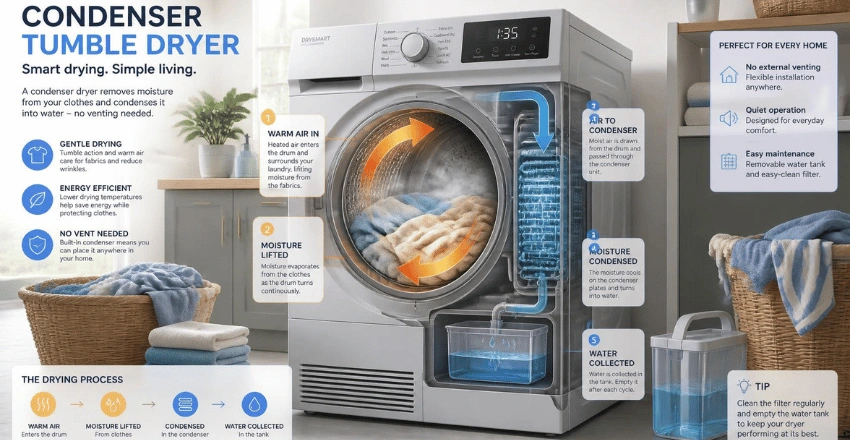
A condenser tumble dryer dries clothes with heated air, then cools the moist air so that the water condenses into a removable tank or is drained away. It does not need an outside vent. Conventional models are usually cheaper to buy and faster than heat-pump dryers, but they use much more electricity and release more heat into the room. More from us: Wet Room Planning in the UK.
| At a glance | What to know |
| Moisture removal | Water collects in a tank or can drain away on compatible models. |
| External vent | Not required |
| Typical tested price range | About £199 to £529 |
| Average tested purchase price. | About £307 |
| Average annual electricity cost | About £137.80 |
| Best suited to | Homes needing flexible placement and a lower purchase price |
| Main drawback | Higher energy use than heat pump models |
| Routine care | Empty the tank, clean the lint filter and maintain the heat exchanger. |
The price and running-cost figures above come from Which? testing and market data updated in July 2026. Its annual cost estimate assumes three loads per week at 70% of the appliance’s rated cotton capacity.
Key Takeaways
- You don’t need an external wall vent, but the room still needs suitable ventilation.
- Conventional condenser models tend to cost less upfront than heat-pump machines.
- Electricity use is much higher, so frequent users may save money with a heat-pump dryer.
- The water tank normally needs to be emptied after each load unless the machine has a drain connection.
- New efficiency requirements in Great Britain are changing which new dryers can be placed on the market.
What is a condenser tumble dryer, and how does it work?
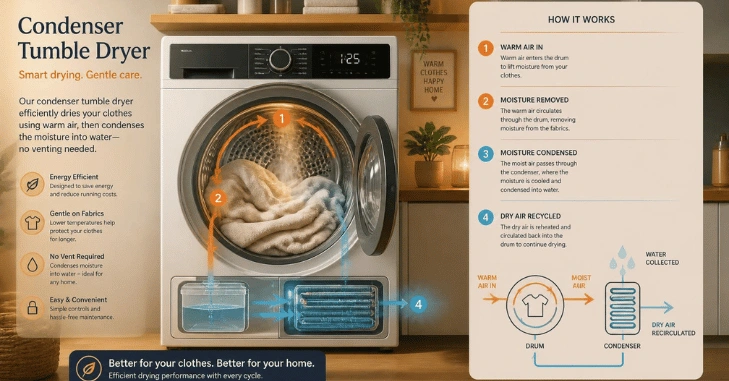
A conventional condenser model uses an electric heating element to warm the air. That air passes through wet laundry and picks up moisture.
The damp air then moves through a heat exchanger. Cooling turns the moisture into liquid water, which collects in a reservoir. Some machines can send this water directly to a drain instead.
This design removes the need for the large, flexible hose used by a vented dryer. That makes installation easier in flats, utility rooms, and kitchens where access to an outside wall is inconvenient.
Most current machines also use moisture sensors. These can stop a program once the load reaches the selected dryness level, rather than running for a fixed period. That can reduce wasted electricity and protect clothes from unnecessary drying.
Why People Still Choose a Conventional Condenser Model
The main appeal is simple installation. You need a suitable electrical supply and enough space around the appliance, but you don’t need to route moist air outdoors.
Other advantages include:
- Lower purchase prices: We found an average tested price of about £307 for condenser models, compared with a much higher average for heat-pump options.
- Often shorter programs: Traditional heating-element machines operate at higher temperatures than heat-pump dryers, which can shorten drying times.
- Flexible moisture disposal: You can empty the tank manually, while some models offer a permanent drain option.
- Sensor-controlled drying: Many machines can stop automatically when clothes reach the selected dryness level.
A condenser tumble dryer can still make sense for a household that dries clothes only occasionally. The lower purchase price may matter more than long-term energy savings if the machine is used infrequently.
The Drawbacks: Electricity, Room Heat, and Maintenance
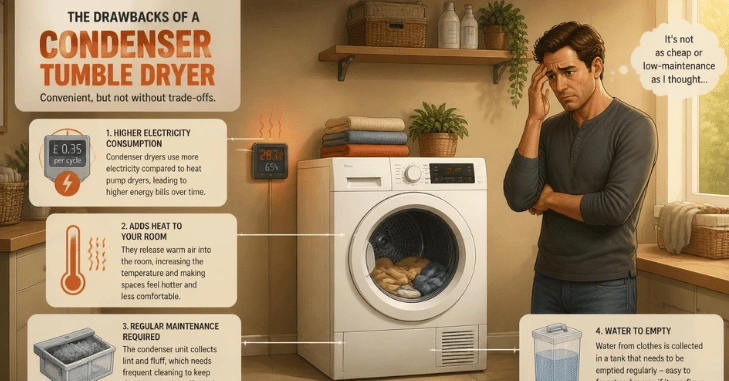
Energy use is the biggest weakness. Which? Estimated an average annual electricity cost of £137.80 for condenser models, compared with £53.90 for heat-pump machines, under the same usage assumptions. That’s a difference of £83.90 per year.
If those costs and usage levels remained unchanged, the difference would amount to about £419.50 over five years. That simple calculation shows why the cheapest appliance at the point of purchase may not be the cheapest one to own.
Traditional models also use hotter air. Samsung and Beko both note that heat-pump technology operates at lower temperatures, which can be gentler on fabrics. Conventional machines can also add more warmth to the room.
You also have more routine maintenance than you would with a vented model. The lint filter needs cleaning, the water container needs emptying, and the condenser or heat exchanger needs periodic care.
Condenser vs. Heat Pump vs. Vented Dryers
| Feature | Traditional condenser | Heat pump | Vented |
| Outside vent needed | No | No | Yes. |
| Water tank | Usually | Usually | No |
| Upfront cost | Usually lower than a heat-pump model | Usually highest | Often low |
| Energy use | High | Lowest of the three | High |
| Drying temperature | Higher | Lower | Higher |
| Typical drying speed | Often quicker than a heat-pump model | Usually slower | Often quick |
| Placement flexibility | Good, with suitable room ventilation | Good, subject to the manufacturer’s instructions. | Limited by the vent route |
| Best fit | Occasional use or a lower budget | Frequent use and lower running costs | Homes with a suitable external vent |
Heat-pump machines also condense moisture, but they recycle heat instead of continually relying on a conventional heating element. That is why they use far less electricity.
For households that run several drying cycles each week, a heat-pump model is usually the stronger long-term choice. A conventional condenser can still suit occasional users who value a lower initial price and quicker programs.
Where can you put one?
“No vent required” does not mean “put it anywhere.” Condenser dryers need access to cooler surrounding air so that the heat exchanger can remove moisture effectively. Beko recommends a well-ventilated room, while Which? says many manufacturers specify operating temperatures between about 5°C and 30°C. Always follow the limits stated in the appliance manual.
Avoid assuming that a sealed cupboard, an unheated shed, or a cold garage is suitable. Poor airflow can increase room temperature and condensation, while temperatures outside the manufacturer’s specified range can affect performance.
If the dryer will be installed in a compact kitchen, Thinkvista’s guide to clever small-kitchen ideas can help you plan for appliance space without making the room feel crowded. Also check how easily you can reach the water tank, lint filter, and condenser. Routine maintenance becomes inconvenient when doors, worktops, or nearby appliances block access.
What the 2026 GB Efficiency Rules Mean for Buyers
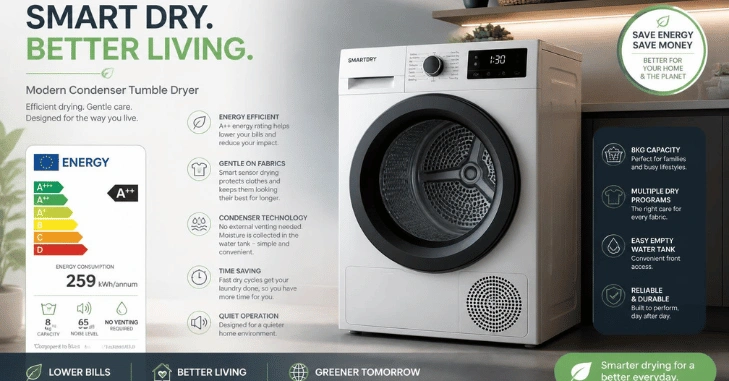
The UK government confirmed stricter ecodesign requirements for tumble dryers in 2026. Its policy includes an energy efficiency index threshold of 85 and minimum condensation-efficiency requirements of 85 or higher. The aim is to phase out inefficient conventional vented and condenser technologies in new supply in favor of heat-pump models.
As of 19 August 2026, the new framework is still moving through its commencement dates. Official legislation indicates that key provisions take effect on 19 September 2026, with further requirements applying from 19 January 2027.
That does not mean households must stop using an existing dryer. The rules concern product standards and machines placed on the GB market.
There’s also a terminology issue. Regulatory documents can use “condenser” broadly enough to include heat-pump technology because both systems condense water. Retailers normally separate “condenser” and “heat pump” into different product categories.
So a headline claiming that “all condenser dryers are banned” can be misleading. When buying a new appliance, check the technology and energy data rather than relying on the category name alone.
How to Keep Your Dryer Working Efficiently
A few small maintenance tasks can help preserve drying performance and reduce wasted energy.
- Empty the water tank after each load. If your model has a permanent drain connection, check the hose for kinks or blockages.
- Clean the lint filter after every cycle. Restricted airflow makes the appliance work harder.
- Clean the condenser or heat exchanger as directed. Which? recommends regular cleaning and stresses the importance of following the manufacturer’s instructions.
- Keep moisture sensors clean. Residue can interfere with automatic dryness detection.
- Keep ventilation openings clear. Don’t push the appliance against surrounding surfaces beyond the clearances stated in its manual.
Once clothes are dry, Thinkvista’s UK ironing-board guide may also help if you want a practical setup for shirts, bedding, and other items that need pressing.
What to Check Before Buying
Don’t choose a dryer based on drum size and price alone. Compare these points first:
- Capacity: Match the drum size to the loads your household normally washes.
- Sensor drying: It can prevent the machine from running longer than needed.
- Annual energy consumption: Compare the energy-label data for the models on your shortlist.
- Drain option: A permanent drain saves you from emptying the reservoir manually.
- Tank position: A high-mounted container may be easier to remove.
- Condenser access: Check how easily you can clean the heat exchanger.
- Room requirements: Confirm the minimum temperature, ventilation, and clearance requirements.
- Repairability: Look at warranty support and access to spare parts before buying.
A slightly more expensive appliance can be cheaper over its working life if it uses much less electricity.
The Buying Decision
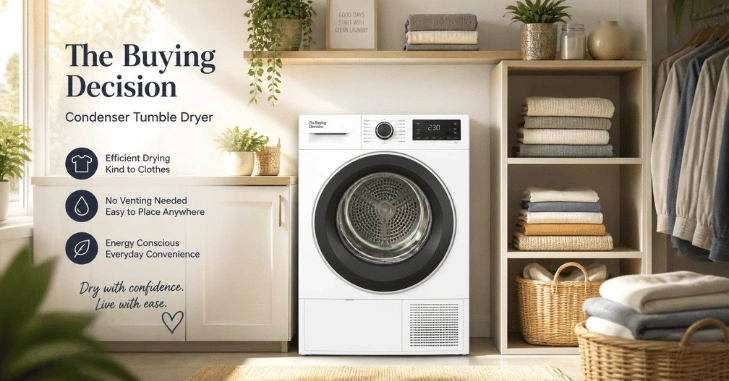
Choose based on total ownership cost, not the purchase price alone. A traditional condenser model may suit occasional drying and a tight purchase budget. If you dry several loads each week, the lower electricity use of a heat-pump dryer can outweigh its higher upfront price.
Before ordering, check annual energy consumption, sensor drying, installation limits, tank access, and estimated five-year running costs.
For more practical appliance, renovation, and household guidance, browse Thinkvista’s Home Improvement guides.
Conclusion
A condenser tumble dryer can still be worth buying in 2026, particularly if you want a relatively affordable appliance that does not require an external vent and you only use a dryer occasionally. Its straightforward installation, flexible moisture collection, and potentially faster drying programs remain useful advantages.
However, electricity costs should be a major part of the buying decision. Conventional condenser dryers generally consume considerably more energy than heat-pump models, meaning a cheaper purchase price can be offset by higher running costs over several years. For households that dry clothes frequently, a heat-pump dryer is often the more economical long-term investment.
Frequently Asked Questions
No. Moisture is condensed into water rather than being sent outside through a large air hose. You still need to place the machine in a suitable, ventilated room and follow the manufacturer’s clearance and temperature instructions.
Plan to check and empty it after every load unless your machine is connected directly to a drain. Which? also recommends cleaning the lint filter each time you use the dryer.
It is often cheaper to buy, but it usually costs more to run. Which? July 2026 figures put average annual electricity costs at £137.80 for condenser machines and £53.90 for heat-pump machines under its standard usage assumptions.
Only if the manufacturer allows it and the location meets its ventilation and temperature requirements. Which? Reports that many manufacturers specify an operating range of roughly 5°C to 30°C so that an unheated garage may be unsuitable in winter.
The more accurate description is that Great Britain is introducing tighter efficiency rules for new products. These standards are designed to remove inefficient conventional technologies from new supply as the rules take effect. They do not require you to stop using an existing machine.