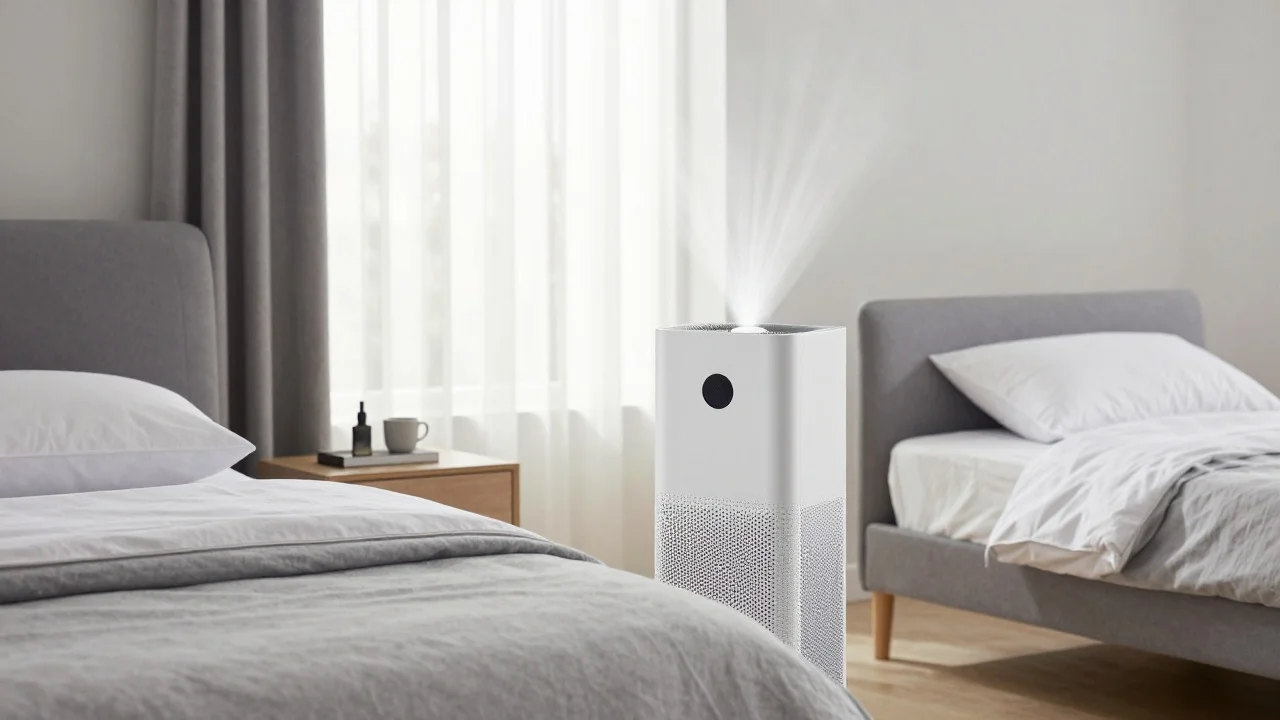
An air purifier is worth considering when you want to reduce airborne particles such as pollen, fine dust, or smoke in one room. For most UK homes, choose a model with adequate CADR for the space, suitable particle filtration, and a noise level you can tolerate. Add activated carbon when gases or persistent odours are a priority.
| What to check | Why it matters |
|---|---|
| CADR | A higher Clean Air Delivery Rate means greater particle-filtering capacity and better suitability for larger spaces. |
| Particle filter | HEPA filters are designed to capture fine airborne particles. Certified HEPA media can theoretically remove at least 99.97% of particles at 0.3 microns. |
| Activated carbon | It is useful when household gases, VOCs, or persistent odours are part of the problem. |
| Noise | A powerful unit is less useful if its noise prevents you from running it overnight or for long periods. |
| Running cost | Which? found annual electricity costs ranging from about £6 to £45 across the models it tested. |
| Mould | Filtration may catch airborne particles, but it cannot fix the moisture source causing mould growth. |
ThinkVista already has a detailed HEPA filtration explainer covering filter technology and maintenance. That page is the better place to learn about the underlying mechanics.
How to choose an air purifier for a UK home
Start with CADR and room size
Don’t judge a machine by the size of its casing or the large room-size figure used in its marketing. CADR is the more useful starting point for particle filtration. EPA guidance recommends choosing a CADR that is high enough for the room you plan to clean. Higher ceilings and open-plan spaces can require greater capacity.
Measure the length and width of the room first. If you’re comparing two similarly priced models, the one with the higher CADR usually gives you more headroom.
Match the filter to the problem
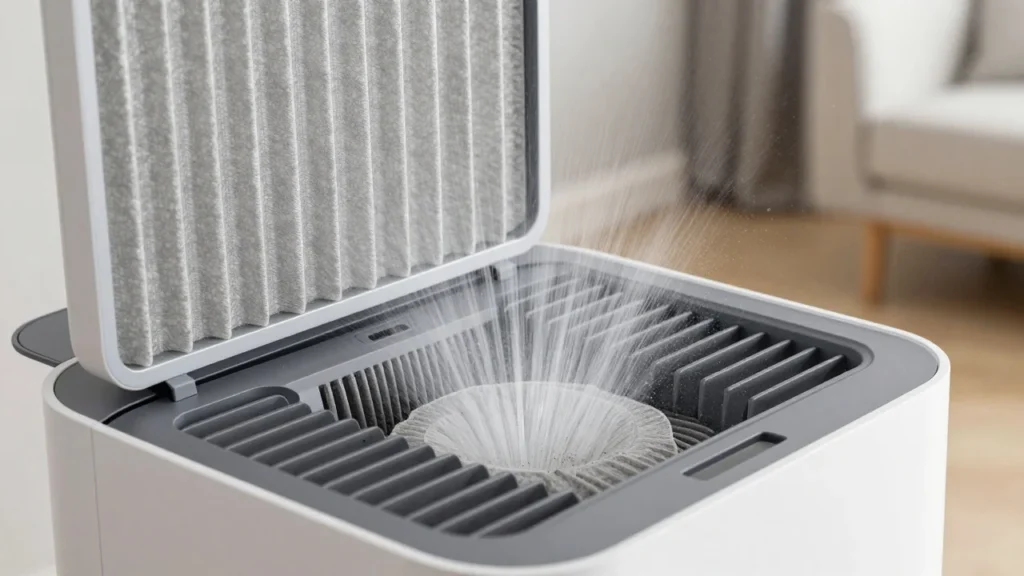
For pollen, dust, and other airborne particles, look for effective particle filtration. HEPA is a common choice. For cooking smells, smoke-related gases, and VOCs, look for activated carbon as well.
Not all carbon filters are equal. EPA guidance notes that the amount of carbon material matters when removing gases.
Count ownership costs, not only the purchase price
The cheapest machine at checkout isn’t always the cheapest to own. Check replacement-filter prices, replacement intervals, and electricity use before ordering.
Which? tested 110 models and found that electricity costs alone could range from roughly £6 to £45 per year. Filter costs are additional.
Five current UK picks compared
Prices were checked using sources available on 19 August 2026 and can change.
| Model | Price checked | CADR | Best suited to |
| Blueair Blue Max 3250i | About £170 | 239 m³/h | Most small to medium-sized UK rooms |
| Coway Airmega 50 | About £70 | 120 m³/h | Smaller rooms and tighter budgets |
| Coway Airmega 350 | About £260 | 598 m³/h | Large and open-plan spaces |
| Dyson HushJet Compact | £349 | 222 m³/h | Buyers who want smart controls and low power use |
| Blueair Blue Mini Max | £72.99 | 100 | Bedrooms, flats, and compact spaces |
1. Blueair Blue Max 3250i: our pick for most homes
Ideal Home ranks the 3250i first in its current UK testing, while The Telegraph also names it its Best Buy. Ideal Home recorded a noise range of 18 to 46 dB, power use of 2.5 to 20 W, and a CADR of 239 m³/h. Argos listed it at £170 when checked.
Pros: Quiet operation, auto mode, app controls, and support from multiple UK testers.
Cons: No timer, less intuitive onboard controls, and a stated coverage limit of 48 m² in Ideal Home’s specifications.
2. Coway Airmega 50: the budget choice
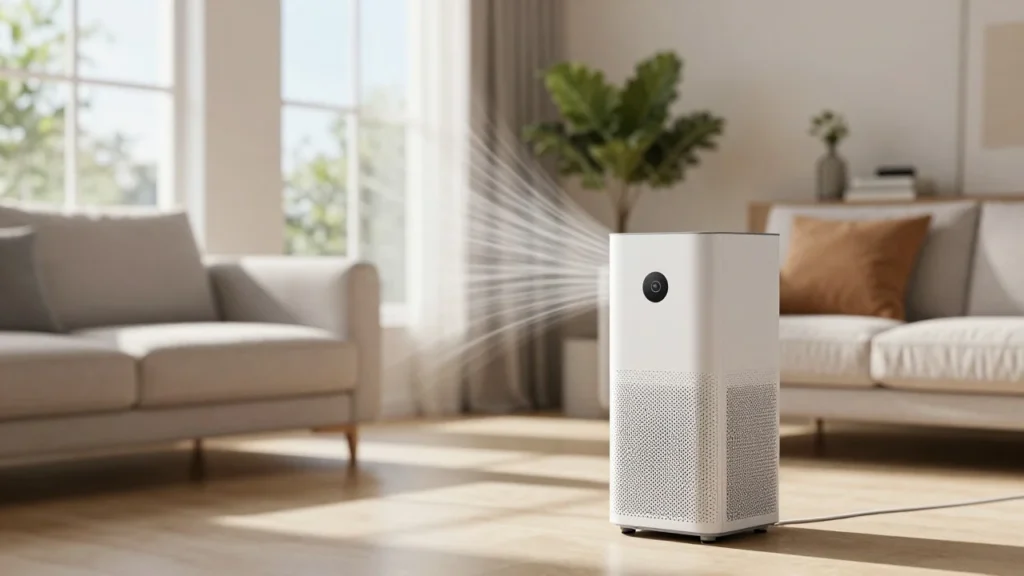
At about £70, the Airmega 50 is a credible lower-cost option for smaller rooms. Current testing lists a CADR of 120 m³/h, an auto mode, and a noise range of 18 to 44 dB.
Pros: Inexpensive, compact, quiet, and automatic.
Cons: No Wi-Fi or app, and testing found weaker performance at lower settings.
3. Coway Airmega 350: the large-room choice
The Airmega 350 offers a much higher CADR of 598 m³/h and is currently positioned as a large-room choice by both The Independent and The Telegraph. Its tested price was around £260.
Pros: High airflow capacity, eco mode, and a strong response to smoke.
Cons: No app connectivity, maximum power consumption of 62 W, and a larger physical footprint.
4. Dyson HushJet Compact: the premium smart choice
The Independent currently ranks the HushJet first in its testing. The test recorded power consumption of 19 W, a CADR of 222 m³/h, and detailed app controls. The price was £349.
Pros: Responsive filtration, strong app features, and low stated power consumption.
Cons: Expensive, and maximum fan noise can reach about 60 dB.
5. Blueair Blue Mini Max: the simple small-room choice
The Mini Max is a stripped-back option for compact rooms. The Independent lists it at £72.99 with a CADR of 100 and highlights its small footprint and quiet operation.
Pros: Compact, simple, and suitable for noise-sensitive spaces.
Cons: No app and no automatic mode.
The verdict: which model should you buy?
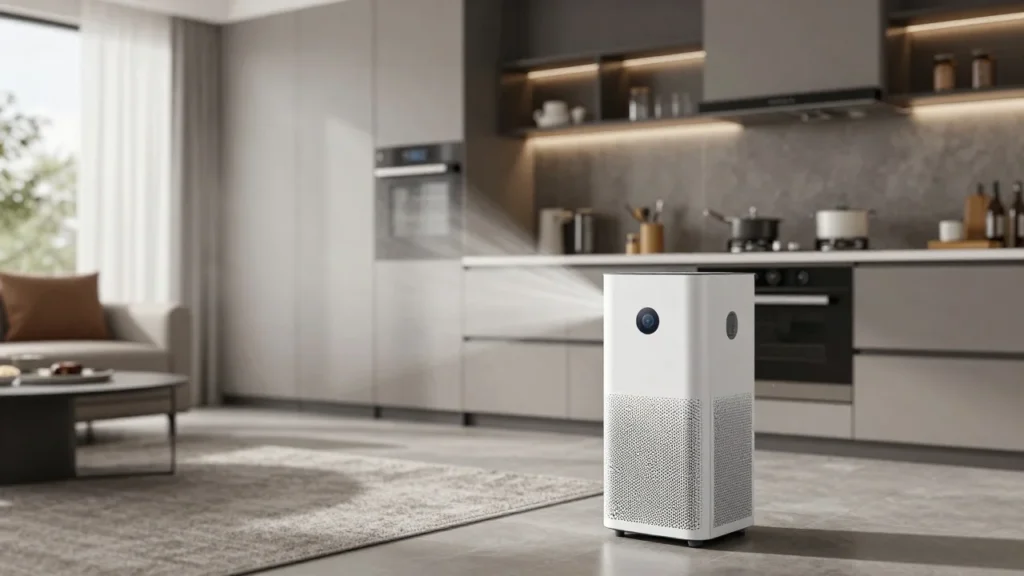
Our pick for most UK households air purifier is the Blueair Blue Max 3250i if its stated coverage of 48 m² suits your room. It combines moderate pricing, quiet operation, smart controls, and support from more than one current UK test roundup.
Choose the Coway Airmega 50 if budget matters most. Move up to the Airmega 350 when you need much greater airflow for a large space. The Dyson makes more sense when detailed smart monitoring matters enough to justify the higher price.
Know what filtration cannot fix
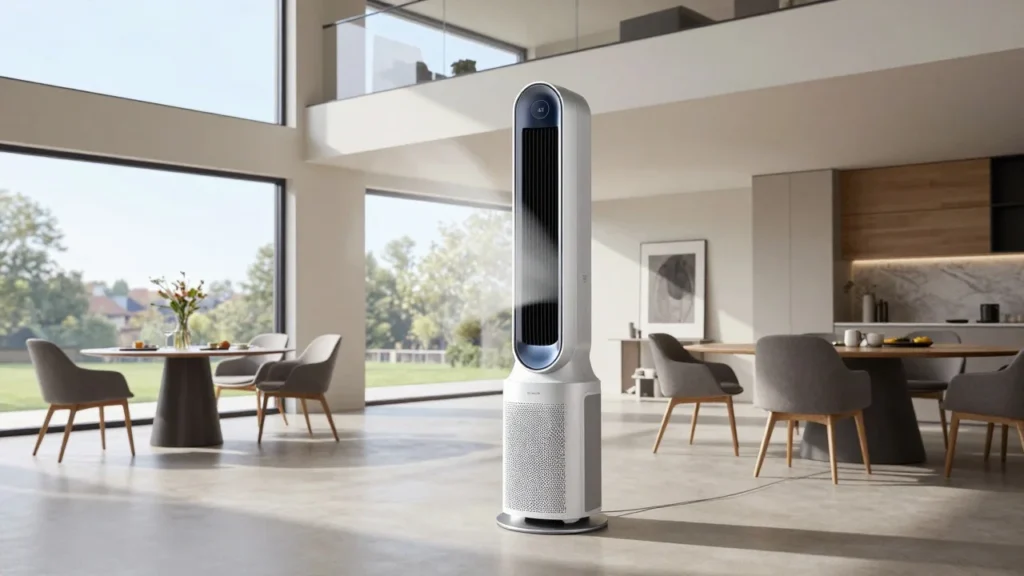
Portable air purifier, cleaners supplement source control and ventilation. They don’t remove every indoor pollutant, and they shouldn’t be treated as a cure for damp or persistent mould. EPA guidance says that mould problems require the moisture source to be removed and the growth to be cleaned up.
Your next step
Measure the room you want to clean and write down your main concern: pollen, fine particles, odours, or a mixture. Compare CADR, noise, filters, and ongoing costs before paying for extra smart features.
For more household technology research, explore ThinkVista’s Tech guides. If you’re planning broader changes around your home, explore the Home Improvement section as well.
FAQs
It can reduce airborne particles such as pollen. EPA-reviewed evidence has found improvements in some allergy or asthma symptoms with portable HEPA cleaners, but the results aren’t consistent for every symptom or every person.
It may catch some airborne particles produced by mould. It cannot remove the moisture problem that allows mould to grow, so the source of the damp still needs to be fixed.
A model containing enough activated carbon can help filter gases and odours. CADR measures particle performance, so don’t use a strong particle rating alone as proof of effective odour removal.
Longer run times and higher fan settings generally filter more air. Place the machine where you spend the most time, keep its airflow clear, and use automatic mode where available.