A multitool can solve the awkward cutting, sanding, and scraping jobs that are difficult to tackle with larger power tools. For UK homeowners, DIYers, and tradespeople, an oscillating tool is particularly useful when working around door frames, flooring, plasterboard, tiles, cabinets, and other tight spaces. The challenge is choosing a model with the right power source, accessory system, and level of control without paying for features you will rarely use.
Quick answer: A multitool is a compact oscillating power tool that accepts interchangeable blades, sanding pads, scrapers, and other accessories. It is especially useful for plunge cuts, flush cuts, grout removal, detail sanding, and working in confined areas. For most UK DIYers, an 18V cordless model offers the best balance of portability and capability.
| Buying question | Practical starting point |
| Best all-round type | 18V cordless oscillating tool |
| Best for occasional DIY | Corded or budget cordless model |
| Best for frequent renovation | Brushless cordless model |
| Most important convenience feature | Tool-free accessory change |
| Best accessory system for premium performance | Starlock-compatible system |
| Main hidden cost | Batteries, chargers, and replacement blades |
| Jobs it does especially well | Plunge cutting, flush cutting, sanding, and scraping |
What Is a Multitool?
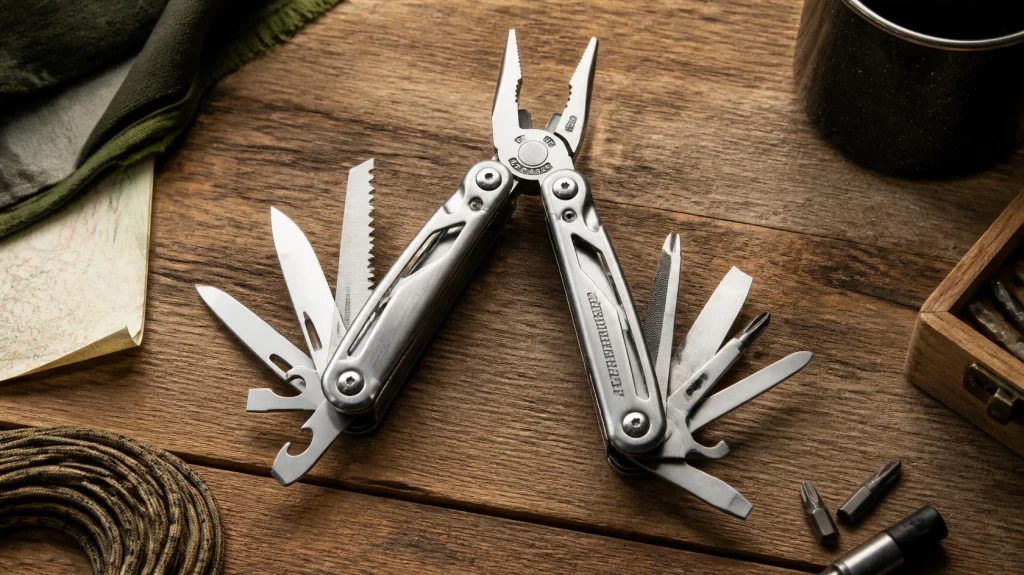
In UK power-tool terminology, the term usually refers to an oscillating machine that moves its attachment rapidly from side to side through a very small angle. Instead of a blade rotating continuously like a circular saw, the accessory oscillates thousands of times per minute, allowing controlled work close to finished surfaces and inside confined spaces. UK retailers currently group oscillating machines from brands including DeWalt, Bosch, Makita, Einhell, and Milwaukee under their multi-tool categories.
Changing the attachment changes what the machine can do, which is the main reason the tool is so versatile. A plunge-cut blade can enter directly into timber or plasterboard, a bi-metal blade can tackle suitable nails and thin metal, and a sanding pad can reach corners that larger sanders struggle to access. Scrapers, grout-removal attachments, and segment blades extend the range of jobs even further.
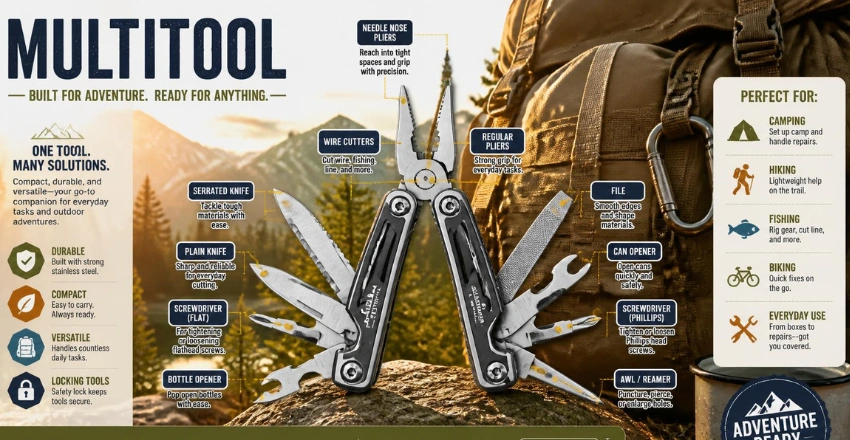
This guide focuses on powered oscillating tools rather than folding pocket tools containing pliers, knives, and screwdrivers. Both products are commonly called multi-tools, so checking which type a page or retailer is discussing can prevent confusion. For household renovation and workshop use, the oscillating type is the version relevant to the cutting, sanding, and scraping applications covered below.
What Can You Use a Multitool For?
The strongest reason to own an oscillating tool is not that it replaces every specialist tool, but that it reaches jobs other tools handle poorly. It can enter a surface without starting from an exposed edge, cut almost flush against an adjoining surface and work in corners where a conventional saw body will not fit. Those abilities make it particularly useful during repairs, flooring installation, decorating, and renovation.
Common applications include:
- Plunge-cutting openings in timber, sheet material, and suitable plasterboard.
- Undercutting door frames before fitting laminate or engineered flooring.
- Trimming skirting, architrave, and other timber details.
- Cutting suitable nails, screws, and thin metal with the correct bimetal blade.
- Removing old grout with a compatible carbide or diamond accessory.
- Scraping adhesive, old sealant, paint residue, and flooring material.
- Detail-sanding corners, edges, frames, and awkward profiles.
- Making small adjustments to cabinets, boards, and interior fittings.
An oscillating tool can be particularly helpful when creating access openings or making small adjustments during plasterboard work. Before starting a larger wall project, Thinkvista’s plasterboard guide explains common UK board types, thicknesses, and applications. Planning the material first makes it easier to select an appropriate blade and avoid unnecessary damage.
Corded or Cordless: Which Should You Choose?
Corded machines still make sense when purchase price matters more than mobility and most work happens near a socket. They provide continuous operation without batteries or charging, which can be useful for long sanding or scraping sessions. The disadvantage is a trailing cable that can become inconvenient when moving between rooms, working on stairs, or operating in tight areas.
Cordless models dominate much of the current professional and enthusiast market because they are easier to position around a project. An 18V machine is particularly attractive if you already own batteries and a charger from the same manufacturer, because a bare tool can then be considerably cheaper than starting a new battery platform. DeWalt, Makita, Bosch, and Einhell all currently offer cordless oscillating models within their wider battery systems.
| Type | Main advantage | Main drawback | Best suited to |
| Corded | Continuous power and lower entry cost | Cable restricts movement. | Workshops and occasional DIY |
| Cordless brushed | Portable and often affordable | Less efficient than brushless designs | General household jobs |
| Cordless brushless | Efficient, powerful, and suited to frequent use | Higher initial price | Renovation and trade work |
| Bare cordless tool | Good value if you own batteries | Battery and charger not included | Existing battery-platform users |
For most people already invested in a reputable 18V platform, staying with that system is normally more practical than changing brands solely for small differences in specifications. Batteries can represent a substantial part of the final purchase cost, and sharing them across drills, saws, and other tools simplifies charging and storage. Compare the cost of the complete working setup rather than only the price printed beside the bare machine.
7 Features That Matter When Choosing an Oscillating Tool
1. Battery Platform and Power Source
Start with the batteries you already own before comparing small differences in speed or headline power. If you have several DeWalt XR, Makita LXT, Bosch Professional, or Einhell Power X-Change tools, buying a compatible body-only machine may save the cost of another battery and charger. Someone buying their first cordless power tool should instead compare the complete kit price and the other machines available on the platform.
2. Oscillations Per Minute
Oscillations per minute, often abbreviated to OPM, describe how rapidly the accessory moves during operation. Current professional cordless models commonly reach around 20,000 OPM, although the useful feature is often speed control rather than the maximum figure itself. DeWalt’s DCS356, for example, provides three capped speed ranges alongside its variable trigger, while Makita’s DTM52Z offers variable operation between 10,000 and 20,000 oscillations per minute.
3. Oscillation Angle
A wider oscillation angle can increase the amount of material removed during each movement, potentially making aggressive cutting faster. Smaller or more controlled movements can feel easier to manage in delicate applications, so the biggest published number is not automatically the best choice for every user. Current examples include a total 3.4-degree oscillation angle on Bosch’s GOP 18V-34 and 3.6 degrees on Makita’s DTM52Z.
4. Accessory Compatibility
Accessory compatibility can affect ownership cost long after the machine itself has been purchased. Universal or OIS-style fittings provide access to a broad selection of blades, while Starlock systems are designed for fast, secure attachment and are available in different performance classes. Check the exact interface before ordering bulk packs because an accessory that looks similar online is not necessarily compatible with every machine.
5. Tool-Free Blade Changes
Blades become hot and wear during cutting, so quick accessory changes are more than a small convenience. DeWalt uses a quick-change accessory clamp on the DCS356, Makita specifies a tool-less clamp on the DTM52Z, and Bosch uses a snap-in system with compatible Starlock accessories on the GOP 18V-34. A tool-free design is especially worthwhile if your project regularly alternates between cutting, sanding, and scraping.
6. Vibration and Ergonomics
Oscillating machines transmit vibration into the hands, which becomes more noticeable during prolonged work. Features such as slimmer grips, balanced battery positioning, and anti-vibration systems can therefore matter more in regular use than another small increase in cutting speed. The UK Health and Safety Executive warns that regular and frequent exposure to hand-arm vibration from powered tools can cause permanent health problems, making exposure control particularly important in occupational use.
7. What Is Actually Included
Check the package contents carefully because “tool only,” “bare unit,” and “solo” normally mean that a battery and charger are absent. You should also see whether the box includes useful blades, sanding sheets, a scraper, dust-extraction accessories, or a storage case. A slightly more expensive kit can represent better value when it contains accessories you would otherwise need to buy immediately.
Current Models Worth Comparing in the UK
There is no single model that is automatically right for every buyer because battery ownership, frequency of use, and accessory preferences change the decision. Current manufacturer specifications nevertheless provide useful benchmarks for understanding what you can expect at budget, mainstream, and premium levels. These models are examples to compare rather than a claim that every reader needs the most expensive option.
| Model | Power | Key specifications | Best suited to |
| DeWalt DCS356N-XJ | 18V cordless, brushless | Up to 20,000 OPM, three-speed caps, quick-change clamp, universal adaptor | Existing DeWalt XR users and regular renovation |
| Makita DTM52Z | 18V cordless, brushless | 10,000–20,000 OPM, 3.6° total oscillation, Starlock Max compatibility, anti-vibration technology | Makita LXT users wanting premium control |
| Bosch PRO GOP 18V-34 | 18V cordless, brushless | 20,000 OPM, 3.4° total oscillation, Starlock system, 1.2 kg without battery | Professional or frequent users prioritizing Starlock and low vibration |
| Einhell TE-MG 18/1 Li-Solo | 18V cordless, brushed | 3.2° oscillation, tool-free change, 0.83 kg body, accessories included | Budget-conscious Power X-Change users |
DeWalt DCS356N-XJ
The DeWalt DCS356N-XJ is an obvious shortlist option for anyone already using the company’s 18V XR batteries. Its brushless motor, variable-speed trigger, three selectable speed limits and tool-free accessory clamp make it flexible across different materials. DeWalt also supplies a universal accessory adaptor, reducing dependence on one proprietary blade format.
Makita DTM52Z
Makita’s DTM52Z is aimed at users who want a more refined professional machine and already own LXT batteries. It combines a brushless motor with anti-vibration technology, a tool-less accessory clamp, and compatibility with Starlock, Starlock Plus, and Starlock Max accessories. The manufacturer specifies variable operation from 10,000 to 20,000 oscillations per minute, making it suitable for both controlled and more aggressive applications.
Bosch PRO GOP 18V-34
Bosch’s PRO GOP 18V-34 combines an 18V brushless motor with the Starlock accessory interface and a total oscillation angle of 3.4 degrees. Bosch lists the bare weight at 1.2 kg and highlights its low-vibration design, slim grip, and tool-free accessory changes. It is a particularly logical option for someone already using compatible Bosch Professional batteries and Starlock accessories.
Einhell TE-MG 18/1 Li-Solo
The Einhell TE-MG 18/1 Li-Solo occupies a more affordable part of the cordless market while remaining part of the broader Power X-Change battery system. It includes a quick-release fastener, speed control, a 3.2-degree oscillation angle and a selection of basic sanding and cutting accessories. At the time of research in September 2026, Einhell’s UK site listed the bare tool at £66.95, although prices and availability can change.
Which Multitool Blade Do You Need?
The accessory matters at least as much as the machine because no single blade performs every task well. Using the wrong blade can slow the job, produce a poor finish and cause premature accessory wear. Always check the blade manufacturer’s material guidance and confirm that the mounting system matches your machine.
| Job | Typical accessory |
| Plunge cutting timber | Wood plunge-cut blade |
| Cutting timber containing suitable nails | Bimetal wood-and-metal blade |
| Flush trimming | Segment or plunge-cut blade |
| Removing grout | Carbide or diamond grout blade |
| Removing adhesive or sealant | Rigid or flexible scraper |
| Detail sanding | Triangular sanding pad |
| Working on thin, suitable metal | Metal-rated bimetal blade |
Do not expect one general-purpose blade to remain fast in every material. Cutting abrasive boards, old fixings, or hard grout can wear accessories considerably faster than clean softwood, so replacement-blade cost should be considered before choosing a system. Keeping several task-specific blades available also reduces the temptation to force an unsuitable accessory through a material.
Multitool vs. Circular Saw: Which One Do You Need?
An oscillating tool excels at short, precise, and awkward cuts, whereas a circular saw is designed for faster, longer cuts through timber and sheet material. Trying to cut a full sheet of plywood in a straight line with an oscillating tool would be slow and difficult, while trying to plunge a circular saw into a confined corner can be inappropriate or unsafe. The tools therefore complement one another rather than competing directly.
If most of your work involves long straight cuts through boards, timber, or panels, read Thinkvista’s circular saw buying guide before deciding which machine to buy. A circular saw should usually handle the main cutting, while the oscillating tool performs finishing cuts, notches, adjustments, and work close to walls or corners. Owning the correct specialist tool for each stage generally produces faster and cleaner results than forcing one machine to perform every task.
How to Use an Oscillating Tool Safely
A compact body can make an oscillating tool appear less intimidating than a large saw, but the blade still moves rapidly enough to cause serious injury. Check the manufacturer’s instructions, inspect the accessory before use and remove the battery or disconnect mains power before changing attachments. The workpiece should also be stable, and you should know what is behind a wall, floor, or panel before making a plunge cut.
Basic precautions include:
- Wear suitable eye protection and other PPE required for the material and task.
- Check the blade or accessory for damage before fitting it.
- Confirm that the accessory is rated for the material you intend to cut.
- Secure loose workpieces before starting.
- Keep fingers and cables away from the cutting path.
- Check for concealed electrical cables, water pipes, or other services before plunge cutting.
- Use suitable dust extraction when cutting or sanding dusty materials.
- Remove the battery or unplug the machine before changing accessories.
- Avoid excessive pressure and allow the blade to cut at its intended rate.
- Monitor vibration exposure when the tool is used regularly or professionally.
Dust deserves particular attention during indoor renovation. HSE guidance recommends controlling wood dust at source with suitable on-tool extraction and notes that appropriate respiratory protection may also be required for many cutting and sanding operations, particularly during longer work or in enclosed spaces. Following those controls also helps keep the cut line visible and reduces dust spreading through the rest of the property.
How Much Should You Spend on an Oscillating Tool?
Occasional DIY users do not automatically need a premium professional machine because a simpler corded or entry-level cordless model may complete their jobs perfectly well. Spending more starts to make sense when you need faster accessory changes, better vibration control, brushless efficiency, stronger battery integration, or a premium accessory interface. Your existing batteries can shift the value calculation considerably, so compare complete ownership cost rather than body-only prices.
Replacement accessories should be included in that calculation because blades are consumables rather than permanent parts of the tool. A cheap machine that requires expensive or difficult-to-find accessories can become frustrating over several years, while widely available blades make regular maintenance and replacement much easier. Before buying, check UK availability for the blade types you expect to use most frequently.
A broader maintenance plan can also prevent buying tools for jobs you do not actually need to perform. Thinkvista’s 2026 home maintenance checklist can help you identify the repairs and upkeep tasks around your property before investing in equipment. Matching purchases to real projects usually produces better value than collecting tools without a defined use.
Final Buying Advice
For most UK DIYers, the sensible starting point is an 18V cordless multitool with variable speed, tool-free blade changes, and readily available replacement accessories. Stay within an existing battery platform where practical, but compare vibration, accessory compatibility, and complete kit cost before committing to a particular model. Professional users who operate the tool frequently have stronger reasons to pay for a brushless motor, better vibration control, and a premium accessory system.
The machine should ultimately be chosen around the jobs you actually perform rather than the longest feature list. A good machine earns its place by making awkward cuts and finishing tasks easier, not by replacing every saw, sander, or scraper in the workshop. Match the accessory to the material, work safely, and use a dedicated tool whenever the job becomes too large or demanding for an oscillating machine.
Frequently Asked Questions
What is a multitool used for?
An oscillating tool is primarily used for controlled cutting, scraping, sanding, and material removal in spaces where larger tools are inconvenient. Typical jobs include undercutting door frames, making plunge cuts, trimming timber, removing grout, scraping adhesive, and sanding corners. Its greatest advantage is the ability to switch accessories and tackle several small renovation jobs with one compact machine.
Is a cordless model worth buying?
A cordless version is usually worth considering when you regularly move between rooms, work away from sockets or already own compatible batteries. An 18V bare tool can represent strong value when the battery and charger are already in your workshop. A corded model may still be the better buy for occasional use where mobility is unimportant.
Can an oscillating tool cut metal?
Yes, an oscillating tool can cut certain metal items when fitted with an accessory designed for that purpose. Bimetal blades are commonly used for jobs such as suitable nails, screws, and thin metal components, although capability varies with the blade and machine. Always check the accessory specification rather than assuming that a blade marked “multi-material” will safely cut every metal thickness.
Can you use an oscillating tool for sanding?
Yes, most oscillating tools can accept a triangular sanding pad that is useful for corners, edges, and confined areas. This makes the machine convenient for detail work around frames, furniture, and smaller repair areas. A dedicated orbital or sheet sander is normally faster and more comfortable when sanding large flat surfaces.
Is an oscillating tool better than a circular saw?
Neither tool is universally better because they are designed for different types of cutting. An oscillating tool is strongest on short plunge cuts, flush cuts, and awkward access, while a circular saw is far better for long and relatively straight cuts through boards and timber. Many renovation projects benefit from using a circular saw for the main cuts and an oscillating tool for the detailed finishing work.
Is Starlock worth paying for?
Starlock can be worthwhile for frequent users who value quick accessory changes, secure attachment, and a broad professional accessory range. However, a machine accepting widely available universal accessories may be cheaper to run for occasional DIY work. The better choice depends on how often you use the tool and which replacement blades are readily available at acceptable prices.