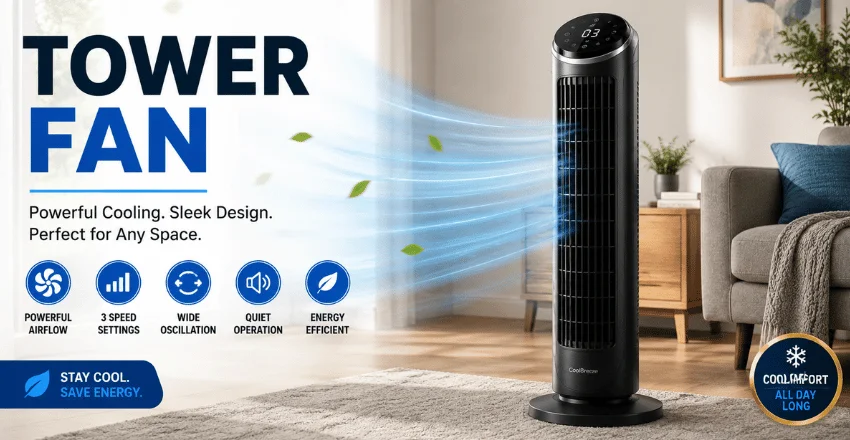
A tower fan is a strong choice when you want useful airflow without giving up much floor space. Its slim shape suits bedrooms, home offices, flats, and smaller living areas. Still, the right model depends on noise levels, power use, airflow control, and where you plan to place it.
| tower fan | What to check | Why it matters |
| Noise | Low-speed sound level and sleep mode | Helps reduce disturbance in bedrooms and offices |
| Power | Wattage listed in the product specifications | You estimate electricity use |
| Oscillation | Sweep angle and directional control | Spreads airflow across more seating or sleeping positions |
| Size | Height and base dimensions | A tall unit can still have a large footprint. |
| Controls | Remote, timer, display, and speed settings | Makes overnight and sofa-side use easier |
| Extra features | App control, purifier, ionizer, or auto mode | Useful only if you will use them regularly |
Like other electric fans, these appliances don’t work like air conditioning. They move air across your body, which can make you feel cooler, but they don’t actively remove heat from the room.
Four Current Models Worth Comparing
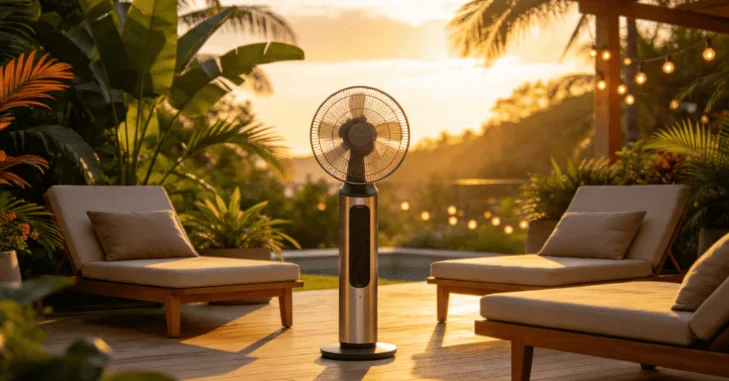
Current UK options range from simple, low-wattage designs to larger premium systems. The table below compares published specifications rather than claiming hands-on testing.
| Model | Power | Speeds/control | Standout feature | Best suited to |
| Dreo Nomad One | 30 W | 8 speeds, remote | Slim 21.3 cm-wide body | Bedrooms and compact rooms |
| Dimplex Ion Fresh | 45 W | 3 speeds, remote | Adjustable tilt and ionizer | Buyers wanting simple directional control |
| Shark TurboBlade TF200SUK | 90 W | 10 speeds, remote | Up to 180° oscillation and adjustable vents | Larger or shared spaces |
| Midea AMS150-PBW | 2-in-1 fan and purifier | 12-hour timer | H13 air purification | Homes wanting airflow plus filtration |
Dreo Nomad One
Dreo’s current Argos listing gives dimensions of 95.8 cm high, 21.3 cm wide, and 19.8 cm deep. It lists eight speed settings, a remote control, 30 W power consumption, and a manufacturer noise claim of 25 dB.
Pros:
- Low published power draw.
- Narrow footprint.
- Eight speed settings.
- Remote control.
Cons:
- A narrow outlet may feel more directional than a larger circulator.
- Manufacturer noise claims don’t always match independent measurements taken in real rooms.
Dimplex Ion Fresh
Dimplex’s current Argos specifications list three speeds, oscillation, adjustable tilt, remote control, and a 45 W rating. It measures about 107 cm tall and has a 31.1 cm-wide base.
Pros:
- Adjustable tilt provides useful directional control.
- Moderate 45 W rating.
- Remote control included.
- Built-in ionizer.
Cons:
- Only three speed settings.
- Wider footprint than the Dreo option.
Shark TurboBlade TF200SUK
The Shark offers a different approach. It can switch between horizontal and vertical positions, offers ten speeds, and oscillates up to 180 degrees. Shark says Boost mode can project air up to 20 meters.
Its published 90 W rating is much higher than those of the Dreo and Dimplex models. The base is also about 75 cm across, so the word “tower” doesn’t necessarily mean compact in this case.
Pros:
- Wide directional adjustment.
- Ten speed settings.
- Suitable for covering several positions.
- Shark lists the low setting at 40 dB.
Cons:
- Large base.
- Higher power rating.
- Premium option compared with basic column designs.
Midea AMS150-PBW
Midea combines airflow with an H13 purification system in the AMS150-PBW. The manufacturer lists a 12-hour delay timer, a net weight of 5.68 kg, and a 38 dB noise specification alongside its filtration system.
Pros:
- Combines air movement and filtration.
- Long timer.
- Useful for buyers who already want an air purifier.
Cons:
- More complex than a basic fan.
- Filtration adds another maintenance requirement.
How to Choose a Tower Fan: 7 Checks That Matter

1. Measure the Floor Space First
Don’t judge size by height alone. Check the base width and depth before buying, especially if you plan to place the fan beside a bed, sofa, or desk. This matters in rooms where every centimeter counts. ThinkVista’s guidance on making compact spaces work harder follows the same principle: measure the usable space before adding another appliance or piece of furniture.
2. Compare Noise at the Speed You’ll Use
Maximum noise matters less if you plan to sleep with the unit running at its lowest setting. Look for independent measurements when possible because manufacturer figures may use different test conditions.
Which? says its fan tests use a decibel meter alongside airflow measurements, giving shoppers a more useful way to compare performance and sound. For bedrooms, also check whether the display can dim or switch off. A good sleep mode should reduce both airflow intensity and unnecessary light.
3. Check Wattage, Not Marketing Claims
A lower wattage usually means lower electricity use over the same running time.
Ofgem’s average electricity unit rate for a Direct Debit customer in England, Scotland, and Wales is 26.11p per kWh from 1 July to 30 September 2026.
At that rate, a 30 W appliance running for eight hours uses:
0.03 kW × 8 hours = 0.24 kWh
That works out at roughly 6.3p for eight hours. A 90 W model would use three times as much energy over the same period, assuming it draws its rated power continuously.
Your actual cost depends on your tariff, speed setting, and the appliance’s real power draw.
4. Match Oscillation to the Room
A narrow bedroom may need only a moderate side-to-side sweep. A shared living room can benefit from wider oscillation or adjustable vents. Consider your furniture before deciding. ThinkVista’s advice on scale, proportion, and leaving room for movement applies here too. Wide oscillation is less useful if a sofa or cabinet blocks half of the airflow.
5. Decide Whether You Need Smart Features
App control can be handy if you want schedules or phone-based adjustments. It isn’t essential for basic cooling.
A remote control and timer cover most everyday needs. Paying extra for Wi-Fi makes more sense if you already use smart-home routines.
6. Don’t Pay for Air Purification Unless You Need It
A purifier-fan combination can reduce the number of separate appliances in a room. That may suit a studio, bedroom, or multifunctional space.
The trade-off is added cost and filter maintenance. If your only goal is stronger airflow, a simpler design may offer better value.
For other ways to make limited spaces more useful, ThinkVista also covers multifunctional furniture for compact homes.
7. Compare a Pedestal Fan Before Buying
Pedestal models often move more air and allow you to adjust the airflow height. Their larger heads, however, take up more visual and physical space.
Column designs usually win on footprint, appearance, and convenient features. Pedestal models tend to win when raw airflow is the priority.
Which Model Would We Choose?
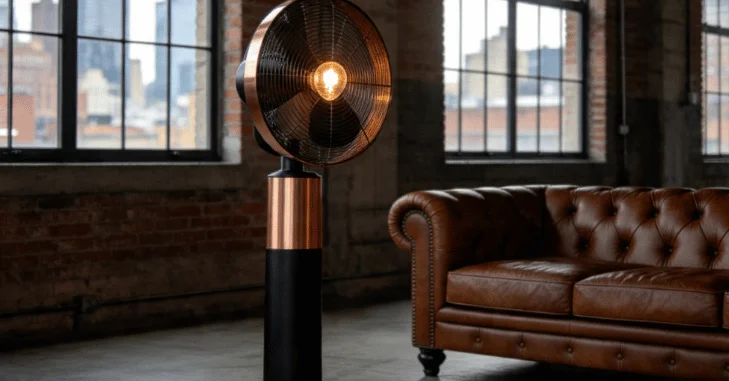
For most buyers, the Dreo Nomad One is the strongest starting point based on its published specifications. Its current UK listing combines a 30 W rating, eight speeds, remote control, and a notably narrow body.
That recommendation is based on specifications and current retail information, not on a ThinkVista hands-on test.
Choose the Shark TurboBlade if wide, adjustable airflow matters more than footprint or power use. Its multi-directional vents and 180-degree oscillation give it greater placement flexibility.
The Midea makes more sense if air filtration is already on your shopping list. The Dimplex offers a simpler middle ground for buyers who value adjustable tilt, remote control, and an ionizer without needing numerous speed settings.
Conclusion
Choosing the right tower fan is less about finding the most expensive model and more about matching its performance to your room and daily routine. Before buying, check the fan’s noise level, wattage, footprint, airflow range, oscillation, controls, and useful features such as timers or sleep modes. The Dreo Nomad One is a strong starting point for compact bedrooms and offices because of its slim design, low published power rating, and multiple speed settings.
The Shark TurboBlade is better suited to larger spaces where wide airflow coverage matters, while the Midea AMS150-PBW is worth considering if air purification is also a priority. The Dimplex Ion Fresh provides a simpler alternative with adjustable tilt and remote control. Most importantly, compare real-world needs rather than marketing features.
Make the Choice Around Your Room
Start with the room, not the feature list. Measure the available floor space, decide how far the airflow needs to travel, and check the wattage and low-speed noise before comparing extra features. For a smaller bedroom or office, a slim, low-wattage design is often the sensible choice. A larger shared room may justify stronger airflow and wider directional control.
You can also browse ThinkVista’s Home Improvement coverage for more practical ideas on making UK living spaces comfortable, functional, and easier to use.
Frequently Asked Questions
Yes, if you want direct airflow, a small footprint, and convenient controls. Pay close attention to low-speed noise, timer options, and display brightness. Remember that a fan cools the person rather than actively lowering the room temperature.
Neither format is best for every room. Pedestal models generally offer stronger and more adjustable airflow. Slim column models are easier to place in narrow spaces and often include timers, remote controls, and sleep settings.
Use this formula:
Wattage ÷ 1,000 × hours used × electricity price per kWh.
At Ofgem’s current average capped unit rate of 26.11p per kWh, a 30 W unit running for eight hours costs about 6.3p in electricity. Your tariff may differ.
Bladeless styling doesn’t automatically mean stronger airflow. Performance depends on the motor, outlet design, airflow speed, and direction. Compare measured performance rather than choosing based on appearance alone.
Prioritise quiet low-speed operation, a timer, several speed settings, and a display that won’t light up the room. Remote control is also useful if the unit sits away from the bed.