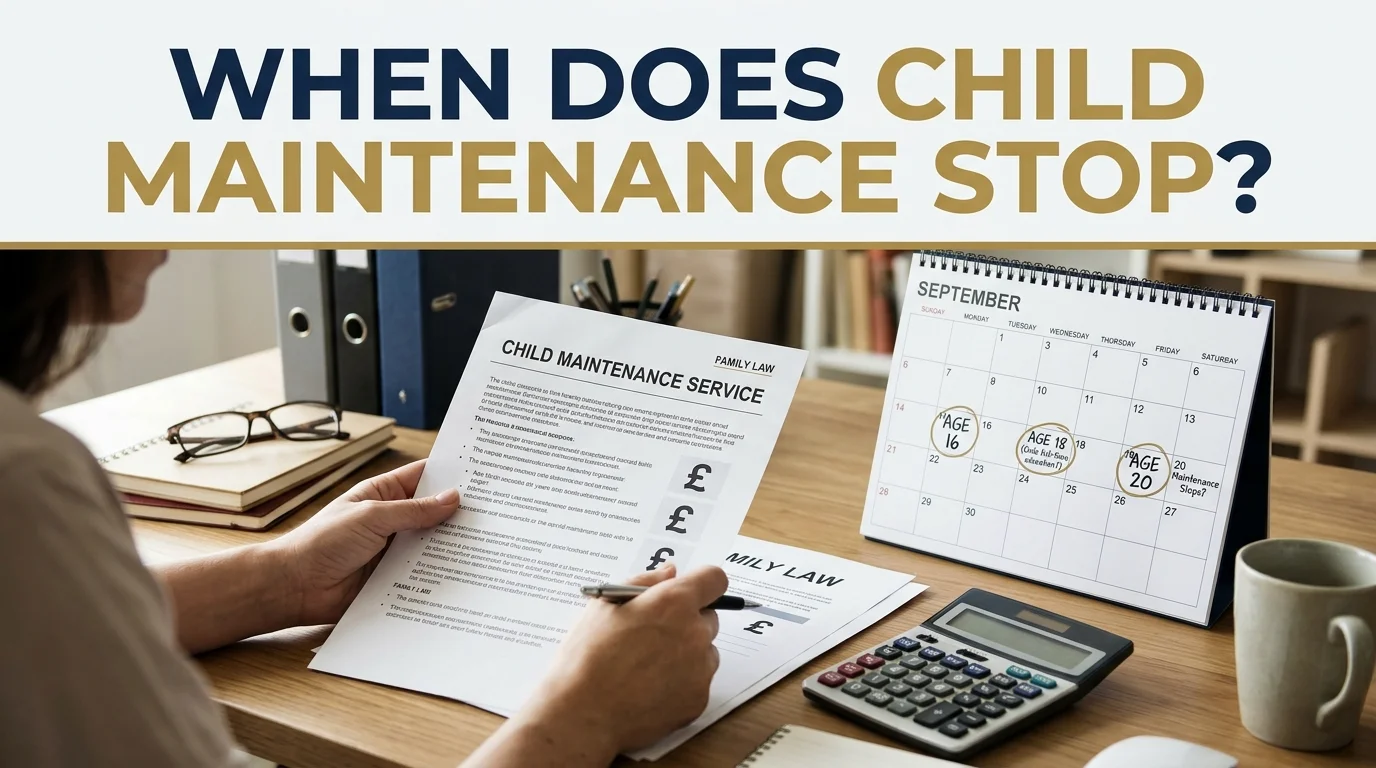
If you are asking when does child maintenance stop, the answer usually depends on your child’s age and education. CMS payments normally continue until age 16. They can continue until age 20 when a child remains in approved education or training. Direct answer: In the UK, statutory maintenance normally ends when a child turns 16 and leaves an approved education or training course. Payments can continue until age 20 while the child continues qualifying education or training. They may end earlier when the qualifying course finishes, although unpaid arrears can still remain due afterward.
| Situation | What normally happens |
|---|---|
| Child is under 16 | Payments normally continue |
| Child is 16–19 in approved education or training | Payments can continue |
| Child leaves approved education or training | Payments normally end at the relevant stopping date |
| Child turns 20 | Regular CMS payments stop |
| Child starts university | Regular CMS payments normally stop |
| Arrears remain unpaid | Outstanding amounts can still be collected |
| Private agreement or court order applies | The agreement or order may set different terms |
When Does Child Maintenance Stop Under UK CMS Rules?
The Child Maintenance Service applies statutory rules to eligible families across Great Britain. A child normally qualifies while under 16. Eligibility can continue under age 20 during approved education or training.
Regular payments end when the child leaves qualifying education or training, or turns 20. Whichever event happens first generally determines the end of the CMS liability.
The exact stopping date can therefore differ between families. Northern Ireland follows closely related rules for its statutory scheme.
Payments can continue to age 20 during approved education or training. Northern Ireland guidance also links entitlement to the child’s educational status.
Does Maintenance Automatically Stop at 16?
Turning 16 does not always end regular support payments. The key question is whether the young person remains in qualifying education or training. A child who stays on an approved course can remain eligible. For example, a 17-year-old studying A levels can usually remain within the statutory scheme.
The same principle can cover Scottish Highers and qualifying vocational courses. Approved programmes generally need to meet the government’s education requirements.
If the child leaves qualifying education after turning 16, payments will normally end. GOV.UK uses set terminal dates when courses finish. These fall at the end of February, May, August or November.
What Counts as Approved Education or Training?
Approved education is usually full-time and non-advanced. GOV.UK defines full-time education as more than 12 supervised hours each week on average. Course-related work experience can count towards those hours.
Qualifying courses can include GCSEs, A levels, T Levels and Scottish Highers. Many vocational qualifications up to level 3 can also qualify. The young person must normally have been accepted onto the course before turning 19.
Some unpaid training schemes can also satisfy the rules. Qualifying schemes differ across England, Wales, Scotland and Northern Ireland. Employer-funded courses and training attached to a job contract generally do not qualify.
Examples of education that may qualify
- GCSEs.
- A levels.
- T Levels.
- Scottish Highers.
- National 5 qualifications.
- Many NVQs and vocational qualifications up to level 3.
- Certain eligible home-education arrangements.
- Specific approved unpaid training programmes.
Parents should check the current government criteria before assuming a particular course qualifies. Course names alone do not always determine eligibility. The course level, hours and funding arrangement can all matter.
Does Child Maintenance Stop When a Child Goes to University?
Regular CMS liability normally ends when a young person enters advanced education. A university degree is specifically treated as advanced education. A BTEC Higher National Certificate is another example given by government guidance.
This can surprise parents because university students can still depend financially on their families. The CMS scheme and wider parental financial support are separate issues. Starting university, therefore, does not mean all financial obligations disappear. Courts can deal with educational expenses in circumstances outside the normal CMS scheme.
Resolution notes that courts may consider university fees or support after secondary education. Specialist legal advice can be useful when substantial post-school costs are disputed.
What Happens If a Child Leaves College Before Age 20?
Leaving an approved course can end eligibility before the child reaches 20. Payments do not necessarily stop on the exact day the student leaves. Government rules use specific terminal dates following the end of qualifying education.
The relevant terminal dates are the last days of February, May, August, and November. The first applicable date after education ends will generally determine when qualifying status finishes. This prevents payment dates from changing unpredictably during an academic term.
Parents should report changes promptly rather than cancelling payments themselves. Education status is connected with Child Benefit information held by HMRC. GOV.UK tells families to notify the Child Benefit Office about relevant education changes.
What Happens When the Child Turns 20?
A young person reaches the upper age limit for regular CMS eligibility at 20. Payments stop after the child’s twentieth birthday under the statutory scheme. Continued attendance at an otherwise qualifying course does not extend normal CMS liability beyond that limit.
This age limit concerns regular statutory payments rather than unpaid amounts from earlier periods. Existing arrears can remain recoverable after ongoing liability ends. A paying parent should therefore not assume that reaching age 20 clears an outstanding balance.
Private agreements and court orders also need separate consideration. Their written terms may define a different duration or specific educational obligations. Review those documents before changing payments.
Can Payments Continue After the Normal CMS End Date?
Yes, but the reason matters. The most common example is an outstanding balance from missed statutory payments. CMS enforcement can continue when arrears remain due. A private family arrangement can also provide support beyond the statutory end point.
Parents can agree how much support is paid and how long it lasts. Such arrangements should clearly record expectations to reduce future disagreements. The court can get involved in specific circumstances. These can include university expenses, disability-related costs, overseas cases and high-income situations.
The court’s powers differ from the standard CMS calculation. ThinkVista readers reviewing broader family finances may also find its guidance on signing a prenup useful. Its estate-lawyer overview covers another area of longer-term family financial planning. These subjects are separate from statutory maintenance rules.
What If There Is a Court Order?

Do not stop payments merely because the normal CMS age rule appears to have been reached. A court order can contain its own duration and conditions. Ignoring those terms could create enforcement problems. English and Welsh law allows certain maintenance orders to extend where education, training or special circumstances justify continued support.
Schedule 1 of the Children Act 1989 contains provisions addressing financial orders for children. The legislation permits exceptions to the usual age restrictions in defined circumstances. A solicitor can check the wording of an existing consent order or maintenance order.
That is especially useful where university costs or disability-related expenses are involved. Individual legal documents should not be interpreted from general online guidance alone.
Does Moving in With a New Partner Stop Payments?
A receiving parent entering a new relationship does not automatically end statutory support for their child. The obligation focuses on the eligible child and relevant CMS rules. A new partner does not simply replace the paying parent.
MoneyHelper also explains that remarriage or cohabitation does not automatically remove a parent’s support obligations. Parents can discuss private arrangements when their wider finances change. Existing court orders should be changed through the proper process.
Report changes affecting a CMS assessment rather than withholding money. The service reviews cases annually and can respond to qualifying changes in circumstances. This approach reduces the risk of accidental arrears.
What Should Parents Do Before Payments End?
First, confirm whether the young person remains in an approved education or training programme. Check the course level, weekly hours, and expected completion date. Do not rely only on the child’s age. Second, review your latest CMS payment plan and online account.
Check whether any arrears remain before treating the case as finished. Missed payments can continue to be collected after regular liability ends. Third, review any private agreement, consent order or other court document. These documents may contain terms that continue beyond normal CMS eligibility. Seek professional advice if their wording is unclear.
Families may also need to reconsider their wider household budget after regular payments change. ThinkVista’s house-deposit guide offers broader reading about household financial planning. Such planning does not alter CMS rules, but it can help families prepare for changing expenses.
Frequently Asked Questions
When does child maintenance stop if my child stays at college?
It can continue until age 20 if the child remains in approved non-advanced education or training. The course must meet the government’s qualifying conditions. Payments can stop earlier if the course ends or eligibility otherwise changes.
Do I pay maintenance while my child is doing A levels?
A levels normally count as approved education under the statutory rules. Payments can therefore continue while an eligible child studies them. The upper age limit remains 20.
Does an apprenticeship count as approved training?
Not every apprenticeship or training programme qualifies. GOV.UK excludes intermediate and advanced apprenticeships from its listed qualifying vocational education. Employer-paid courses and programmes linked to employment contracts also generally fall outside the approved rules.
Does maintenance continue during university?
Standard CMS liability normally ends when the child begins advanced education such as a university degree. Other agreements or court-based support may still apply. University costs can therefore require separate consideration.
Can I stop paying if I think my child has left education?
Confirm the change and use the proper reporting process first. Stopping payments unilaterally can create arrears if liability has not legally ended. Check your CMS account or contact the service when the position is uncertain.
What happens to unpaid maintenance after my child turns 20?
Outstanding arrears do not automatically disappear when regular liability ends. CMS can still pursue money that became due earlier. Paying parents should check their balance before assuming the case is financially closed.
The Bottom Line
For most UK families using the statutory system, the crucial ages are 16 and 20. Support normally continues past 16 only while approved education or training continues. University-level study normally falls outside the standard CMS scheme.
Private arrangements, court orders and unpaid arrears can change what happens next. Check the exact arrangement before cancelling or expecting payments to end. This is particularly important where education costs or special circumstances remain unresolved.
If an end date is approaching, check the child’s course status and your latest payment plan. Report relevant changes through the official channels before altering payments. Seek specialist legal advice if a court order applies or unusual circumstances arise.