The cable lateral raise is a single-arm cable isolation exercise. It builds shoulder width by targeting the lateral deltoid through controlled arm abduction. It uses a low-pulley setup with a neutral grip and slight elbow bend. The arm is lifted to about 90° shoulder height with strict control and stable posture. It is usually performed in 3–5 sets of 10–15 reps for muscle growth.
The cable lateral raise follows a lifting phase of 1–2 sec and a lowering phase of 2–4 sec. Proper nutrition supports results with 1.6–2.2 g/kg protein, 45–55% carbohydrates, and 20–30% fats for balance. Pre-workout meals with 30–60 g carbs improve performance and energy. Post-workout nutrition with 25–40 g protein and 40–80 g carbs supports Recovery, glycogen restoration, and shoulder development over time.
| Basics | Details |
| Exercise type | Single-arm cable movement |
| Muscle focus | Lateral deltoid primary target |
| Key benefit | Shoulder width increase gain |
| Resistance type | Constant cable tension load |
| Setup position | Side stance cable machine |
| Body posture | Upright core-engaged position |
| Starting grip | Neutral grip, elbow slight bend |
| Lift direction | Side abduction movement path |
| Range limit | Up to 90° shoulder height |
| Concentric phase | 1–2 sec controlled lift |
| Eccentric phase | 2–4 sec slow lowering |
| Peak contraction | Hold 1–2 sec at top |
| Dead spot | Minimal due to constant tension |
| Tempo guide | 1–1–3–0 rhythm pattern |
| Weekly volume | 12–18 total sets |
| Protein intake | 1.6–2.2 g/kg bodyweight |
| Carbohydrate intake | 45–55% total daily calories |
| Fat intake | 20–30% total calories range |
| Pre workout | 30–60 g carbs + protein |
| Post workout | 25–40 g protein + 40–80 g carbs |
Understanding The Cable Lateral Raise Exercise
The cable lateral raise is a shoulder isolation movement that targets the lateral deltoid by using a cable machine to control arm abduction. It involves lifting the arm to the side against constant resistance from a low pulley, usually up to shoulder height. This exercise improves shoulder width, enhances muscular symmetry, strengthens stabilisers, and supports better posture and upper-body pressing strength efficiently and safely.
Benefits
- It provides constant resistance throughout the 0–90-degree range, significantly increasing time under tension.
- This improves lateral deltoid activation, muscle symmetry, and shoulder width development.
- It also strengthens stabilisers, reduces momentum use, and improves posture.
- Compared to free weights, it maintains continuous load,
- Making hypertrophy more efficient and controlled across all repetitions performed.
Exercise Setup and Positioning

Set the pulley at the lowest point with a D-handle attached. Stand sideways at arm’s length so the cable remains slightly tense even at rest. Feet should be shoulder-width apart for balance. Keep torso upright, chest open, and core engaged. Proper setup ensures stable movement, better alignment of resistance, and consistent muscle activation throughout each repetition.
How to Perform?
- The cable lateral raise begins with a neutral grip and slight elbow bend.
- Lift the arm to shoulder height, approximately 90 degrees from the torso.
- Pause briefly at the top, then lower slowly over two to four seconds.
- Maintain strict posture, avoid swinging, and ensure controlled movement for maximum lateral deltoid engagement and safety
7-Day Schedule For The Exercise
| Day | Focus | Training | Sets × Reps | Rest | Nutrition | Recovery |
| Day 1 | Strength | Cable lateral raise moderate load, strict form | 4 × 10–12 | 90s | Carbs + protein pre, protein + carbs post | 7–9h sleep, light stretching |
| Day 2 | Active Recovery | Mobility, band work, no weights | — | — | High protein (1.6–2.2g/kg), hydration | Light stretching, walk |
| Day 3 | Hypertrophy | Slow eccentric focus | 5 × 12–15 | 60s | Pre carbs + protein, post protein + carbs | Muscle recovery focus |
| Day 4 | Rest | No training | — | — | Balanced diet, fluids 2.5–3.5L | Full rest, sleep |
| Day 5 | Strength | Heavier load, controlled reps | 4 × 8–10 | 90–120s | Carb + protein pre/post | Joint Recovery |
| Day 6 | Pump | Light weight, high reps, holds | 4–5 × 15–18 | 45–60s | Electrolytes + carbs + protein | Blood flow, mobility |
| Day 7 | Rest | Full rest | — | — | Maintain protein intake | Recovery sleep, relaxation |
Muscle Activation Pattern
In the cable lateral raise exercise, the lateral deltoid is the primary mover during shoulder abduction, while the anterior deltoid assists stabilization. The supraspinatus initiates the first 15–20 degrees of movement. Upper trapezius and serratus anterior support scapular control. Rotator cuff muscles stabilize the joint throughout the lift. This coordinated activation ensures smooth mechanics, controlled motion, and reduced risk of shoulder imbalance or strain.
Concentric Phase Mechanics

During the concentric phase, the arm moves away from the body against resistance, shortening the lateral deltoid fibers. This phase lasts about one to two seconds for optimal activation. Controlled lifting improves motor unit recruitment, reduces reliance on momentum, and enhances muscle efficiency. Maintaining steady tension ensures the shoulder remains engaged throughout the entire lifting portion.
Eccentric Phase
The cable lateral raise becomes more effective when the eccentric phase is slowed to two to four seconds. During lowering, muscle fibers lengthen under tension, creating microtrauma that supports hypertrophy. Controlled descent improves joint stability and tendon resilience. Fast lowering reduces muscle activation and limits growth potential, making tempo control essential for long-term success in shoulder development.
Peak Contraction and Joint Angle
Peak contraction occurs when the arm reaches 80–90 degrees of abduction. At this point, the lateral deltoid experiences maximum tension. Holding this position for one to two seconds increases neuromuscular activation and improves muscle control. This brief isometric pause enhances the hypertrophy stimulus without requiring heavier loads, making training more efficient and joint-friendly overall.
Dead Spot Elimination Advantage
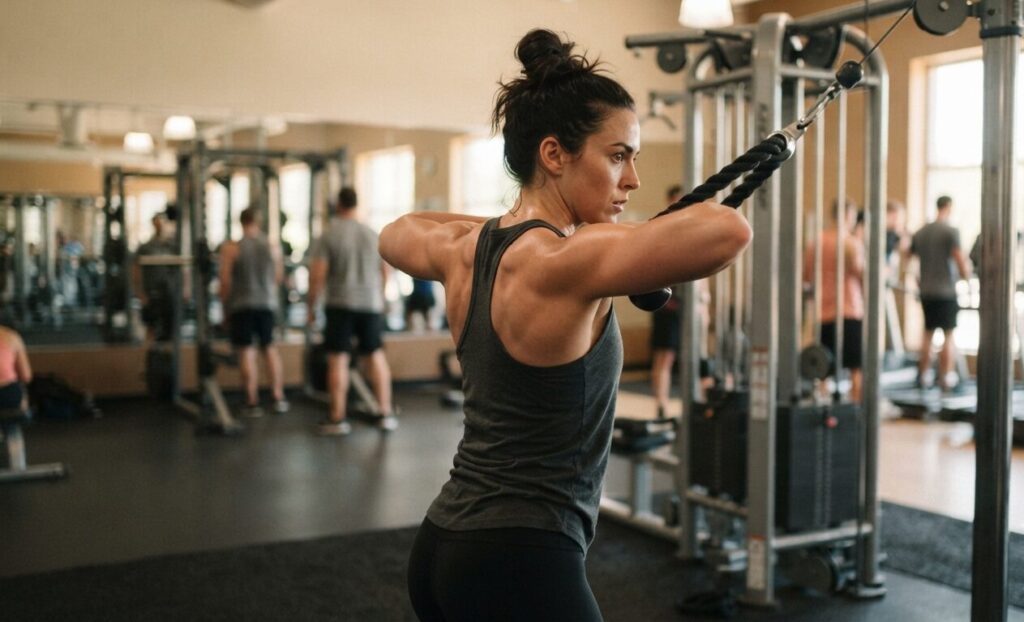
In the cable lateral raise exercise, Cable resistance reduces the dead spot seen in dumbbell raises where tension drops at the bottom. With cables, resistance remains consistent from 0–90 degrees, ensuring continuous muscle engagement. This eliminates relaxation phases, increases effective training volume, and improves shoulder activation. Constant tension results in smoother movement patterns and a more efficient hypertrophy stimulus during every repetition.
Range of Motion Control
The ideal range begins near the thigh and ends at shoulder height, approximately 90 degrees. Going higher shifts emphasis toward the trapezius rather than the lateral deltoid. Maintaining strict range ensures targeted muscle development, joint safety, and better activation. Controlled ROM also prevents compensatory movement patterns, supporting consistent shoulder growth and improved training precision over time.
Tempo and Movement Speed
- A structured tempo of 1–1–3–0 is ideal, meaning 1 second of lifting, 1 second of hold, and 3 seconds of lowering.
- This increases time under tension and improves muscle activation.
- Slower eccentric phases enhance the hypertrophy response, while controlled lifting prevents the use of momentum.
- Proper tempo ensures better muscle fibre recruitment and improves overall exercise quality during shoulder isolation training sessions.
Training Volume and Figures

For the cable lateral raise exercise, effective training includes 3–5 sets of 10–15 repetitions per session. Weekly volume should range between 12–18 total lateral deltoid sets for optimal growth. Load should allow strict form across all repetitions. If fewer than 10 reps are possible, weight is too heavy. If more than 15 reps are easy, resistance is too light for growth stimulus.
Nutrition for Muscle Growth
Muscle development requires 1.6–2.2 g protein per kg body weight daily. For a 70 kg individual, this amounts to 112–154 g of protein. Carbohydrates should provide 45–55% of total calories for energy, while fats should remain at 20–30%. Hydration of 2.5–3.5 litres daily consistently supports performance, Recovery, and muscle function during resistance training sessions.
Pre-Workout Fuel Strategy
Consume a balanced meal 60–120 minutes before training. An ideal intake includes 30–60 g of carbohydrates and 20–40 g of protein, with low fat, for optimal digestion. This improves energy availability, enhances muscular endurance, and supports better performance during shoulder isolation work. Proper pre-workout nutrition ensures sustained strength output and better exercise quality throughout training sessions.
Post-Workout Recovery Nutrition
After training, consume 25–40 g protein within 1–2 hours to support muscle repair. Add 40–80 g carbohydrates to restore glycogen levels. This combination accelerates Recovery, reduces soreness, and improves adaptation. Electrolyte hydration further enhances cellular repair and supports protein synthesis. Proper post-workout nutrition is essential for consistent shoulder development and long-term strength gains.
Recovery and Muscle Relaxation

After the cable lateral raise exercise, Recovery requires 7–9 hours of sleep for optimal hormonal balance and tissue repair. Light stretching reduces shoulder tightness, while mobility drills improve joint function. Foam rolling enhances blood flow in deltoids and upper back. Rest periods of 48–72 hours between sessions allow full Recovery. Proper relaxation prevents overuse injuries and effectively supports long-term training performance.
Common Technical Errors
- Common mistakes include using excessive weight, swinging the torso, shrugging shoulders, shortening range of motion, and rushing repetitions.
- These errors reduce lateral deltoid activation and increase the risk of injury.
- Maintaining strict posture, controlled tempo, correct range, and moderate resistance ensures proper muscle engagement.
- Consistently eliminating these faults significantly improves training efficiency and long-term shoulder development.
Conclusion
The cable lateral raise is an effective shoulder isolation exercise that builds lateral deltoid strength, improves shoulder width, and enhances muscular balance when performed with proper form and control. Using a smooth tempo and moderate sets with 10–15 repetitions helps maintain consistent progress over time.
The cable lateral works best when supported by balanced nutrition, including sufficient protein and carbohydrates, along with proper Recovery and sleep. When performed regularly with good technique, it efficiently and safely improves shoulder stability, posture, and long-term upper-body strength.
If you want to read an interesting article about it, explore our Fitness category.
FAQs
It is a single-arm cable-isolation movement targeting the lateral deltoid, improving shoulder width, symmetry, posture, and upper-body pressing strength with controlled resistance.
It maintains constant cable tension across 0–90 degrees, increasing time under tension, enhancing muscle fibre activation, and improving hypertrophy compared to free-weight variations.
Stand sideways to a low pulley, lift the arm to 90° shoulder height with a neutral grip, then lower it slowly with a controlled 2–4-second eccentric phase.
The primary muscle is the lateral deltoid, supported by the anterior deltoid, supraspinatus, rotator cuff, and upper trapezius, ensuring stability and smooth shoulder joint movement.
Using excessive weight, swinging the torso, shortening the range of motion, rushing repetitions, and shrugging the shoulders reduce effectiveness and increase the risk of shoulder strain.